by KimMcLaughlin | Jun 22, 2026 | Uncategorized
What is Mental Health Awareness?
During Mental Health Awareness Month, I want to share the 6 Pillars of Mental Health a framework I use with therapy clients to create meaningful, sustainable change. You can also listen to this topic on the Feed Your Soul with Kim Podcast.
Mental health awareness has become more recognizable over the course of many years.
The movement originated in the early 1900s, it exploded into mainstream public consciousness during the 1990s due to new brain science, and again in the 2010s through social media, celebrity advocacy, and global campaigns.
Some reasons for mental health awareness are:
- Reduce stigma. The CDC recognizes mental health stigma as
- “Stigma refers to negative attitudes, beliefs, and stereotypes people may hold towards those who experience mental health conditions.
- Stigma can prevent or delay people from seeking care or cause them to discontinue treatment.
- We can all play a part in helping to reduce mental health stigma.”
- Increase access to mental health services
There is a lack of access to mental health services. I hear about it daily in my work as a therapist.
- Normalize our discussions about mental health.
There is a stigma when we talk about mental health issues. Clients and people, I meet say they cannot tell others about their mental health symptoms for fear that they will be rejected.
Today, I want to walk you through a framework I use with clients: Six pillars that support real, sustainable mental health. We are going to make this conversation an honest and real one.
What Are the 6 Pillars of Mental Health?
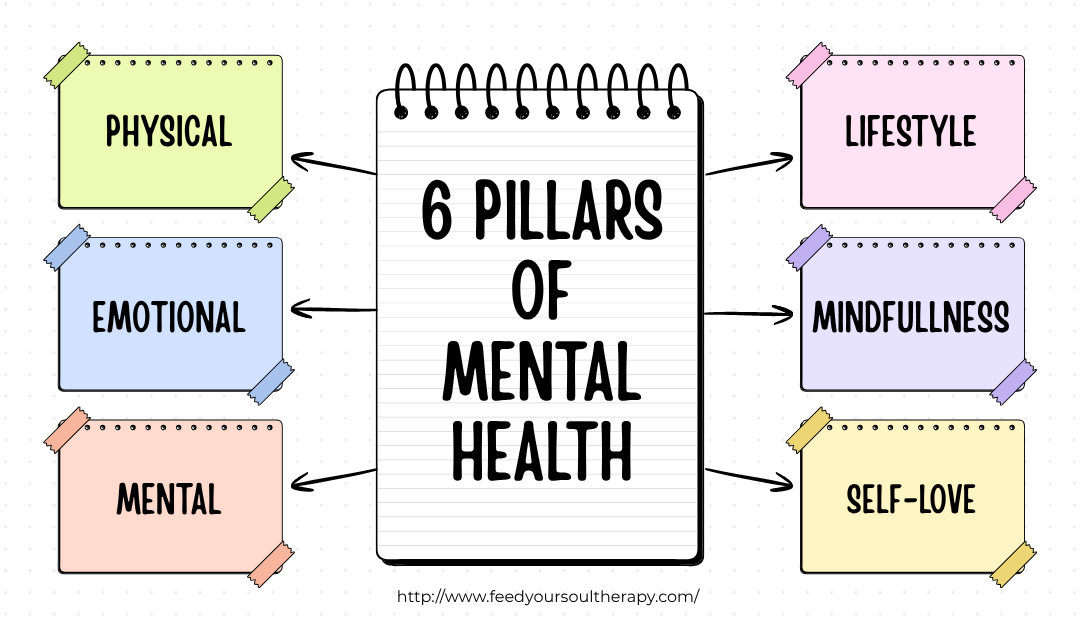
Mental health is multi-dimensional and that is why I talk about the 6 pillars of mental health. These 6 pillars are the foundation of the totality of who you are and how you can be mentally well.
The six pillars of mental health are:
- Physical Health
- Emotional Health
- Mental Wellness
- Lifestyle
- Mindfulness
- Self-Love
I find that many “Self-Health” gurus focus on one of the pillars, maybe two AND this is insufficient to create lasting change.
Together, these pillars create a holistic foundation for emotional resilience, stress management, and overall mental wellness.
The 6 Pillars of Mental Health
-
Physical Health
Your body and mind are not separate. We are learning more about the connection between how our body functions and how we are thinking and feeling.
When we look at physical health the attention often falls to weight. I have talked about weight issues and weight stigma often. Nutrition is one of the many aspects of physical health and there are quite a few other areas:
- Sleep
- Movement
- Nutrition
- Nervous system regulation
When we are “off” it tends to show up physically. Our nervous system regulation shows up in physical symptoms that can clue us onto a problem.
I like to ask myself the question, “What is your body trying to tell you right now?”
Tools that can increase your physical health.
It can be easiest to start with one small habit
-
- Hydration
- Walking
- Consistent sleep time
- Food that nourishes your body
-
Emotional Health
Let’s start with a key fact that feeling emotions is not the problem, avoiding them is. In my practice as a psychotherapist avoiding feelings is often the result of a year’s long pattern of disconnecting from our emotions.
It makes sense to disconnect from feelings that are upsetting, because you do not know what to do with them. I know that the more you avoid them, the more they show up at others times unannounced.
I think the starting point with all these pillars, especially, is to start being curious and recognize them. Emotional Awareness is the first step.
Suppressing emotions means we are out of touch with so many parts of ourselves: our emotions, our physical sensations and we can then be out of touch with the people around us.
This is a process that is gathered over time. I invite my clients to
- Sit with feelings
- Name their emotions
- Be curious about them
I like asking the questions:
- What emotion have you been avoiding lately?
- What emotion has been showing up often?
Tools can increase your Emotional Health.
- Name the feeling → locate it in the body → allow it.
- Naming the feeling can be simple if you use some basic terms:
- Happy
- Sad
- Scared
- Lonely
- Bored
- Angry
- After you name the feeling, locate it in your body. Where in your body are you feeling this? Some places I find my clients identify are:
- Anger is found in their tense neck
- Frustration is found in their tight shoulders
- Sadness is found in their tears
- Fear is found in their tight chest
- It can be scary to allow yourself to feel the feeling. When we sit with a feeling with some intention, it does slip away. The feeling will not be there forever.
- If emotional overwhelm feels difficult to manage, therapies such as Brainspotting can help address deeper patterns stored in the nervous system.
-
Mental Wellness (Thought Patterns)
Our thoughts can be indicative of a problem in our lives. Our thoughts can be overwhelming and intrusive in a way that can be quit negative.
Thoughts shape perception AND they’re not always truth.
I tell my clients that just because they think something does not make it true.
Thoughts are indications there is an inner critic that wants to bring us down.
Our thoughts can add information that we do not know to be true. It is like our thoughts can get 10 steps ahead of a situation AND make it worse.
There is also a tendency to put meaning to what others are saying/doing that is not based on the truth at that moment.
I like the THINK acronym
- T= Is it true.
- H= Is it helpful
- I= Is it inspiring
- N= Is it necessary?
- K= Is it kind.
You do not have to believe every thought that you have. I say you made the thought up and you can unmake it up. Meaning you can investigate the thought to see if it is true.
What are Mental Wellness Tools?
I find it is helpful slow down and questions what our mind is telling us is true.
- Recognize whether there is some agitation or dysregulation in your body.
- Take a deep breath.
- Ask yourself, What do I know to be true?
- Wait for the answer and keep breathing.
- If the thoughts are positive and helpful you are probably moving in the right direction.
Generally, we are responding from our inner critic. The voice in our head that tells us we are wrong or others are wrong.
It is the part of our head that also makes things up. We make up stories in our head that is not always based on reality.
-
Lifestyle
How you move through your daily life either supports or drains your mental health.
The Lifestyle Pillar for mental health is a significant one. Lifestyle is about your day-to-day life.
Think of the Lifestyle Pillar as:
- Work/School
- Family/Children
- Play
- Money
- Family of Origin
- Social Relationships
As you might be able to tell, the Lifestyle Pillar plays into all the other pillars. Emotions and thoughts affect how we live our lives on a day-to-day basis.
In recognition of the vastness of this pillar, lets look at how we can address what shows up in our relationships.
Boundaries play a huge role in how we address what goes on in our lives. Boundaries are ultimately how we can take care of ourselves AND not take care of ourselves.
- Can you embrace a work/life balance?
- Do you people please and let others take advantage of you?
- Do you say yes when you mean no?
- Do you take care of others at your own expense?
Increase your Lifestyle response
Tools that we want to embrace in our Lifestyle is ones that help us determine what is important to us.
-
- What aspect of your life causes you concern?
- Where in your life are you saying yes when you should say no?
- One boundary you can set this week?
-
Mindfulness
Mind/body/spirit awareness creates choice and opportunity.
Mindfulness is simply being present in yourself without judgment
There are so many misconceptions about Mindfulness. It is not about clearing your mind and taking away your thoughts or feelings.
Mindfulness is about getting quiet to hear, ultimately, that still small voice inside of you.
The benefits of mindfulness is that it interrupts going into autopilot with our thoughts, feelings and behaviors.
Mindfulness Tools
- Try breathing in for 6 second breath, hold for 6 seconds and then let the air out for 6 seconds. This can be the reset that you need when upset.
- Wash your hands with cool water and a lovely smelling soap!!! Extra points for putting on a lotion you love.
- Walk outside and feel your feet on the ground. This is a fantastic grounding exercise.
-
Self-Love
Your relationship with yourself (self-love) sets the tone for everything else.
We live in a society that is so critical and I find our thoughts can be equally critical.
Self-Love gives us an opportunity to calm down our mind, thoughts and behavior.
We need to reframe Self-Love:
- It is not a bubble bath.
- It is not a pedicure.
- It is the way you talk to treat ourself.
Many high-achieving women believe self-criticism keeps them motivated. They focus on telling themselves what they do wrong, which ends up feeling defeating.
Chronic self-judgment often increases anxiety, burnout, and feelings of inadequacy.
The inner critic can run wild AND the antidote is self-love.
There are many tools to increase Self-Love
-
- Would you talk to someone you love the way you talk to yourself?
- Practice replacing harsh self-talk with neutral/compassionate language
- Imagine talking to yourself as if you were a younger child. What would you say to them?
How the Pillars Work Together
These 6 pillars are interconnected, not separate silos. You need all of them in balance.
Poor sleep (physical) can lead to emotional reactivity, which can lead to negative thinking and ends in strained relationships.
You can’t fix everything at once, that is impossible!
Ready to strengthen your mental health?
The good news is you do not have to focus on all 6 pillars of mental health all at once!
Over time as you move through all the pillars, you will notice a subtle shift in your feelings about yourself and your life.
Let’s create some mental health habits. Here is your invitation to choose one pillar to focus on this week.
Physical Pillar
- Take a walk 1 time this week.
- Drink 8oz of water daily.
- Go to bed at a regular time.
Emotional Pillar
- Name an emotion as you feel it.
- Acknowledge your emotions.
- Write about an emotion in a journal.
Mental Pillar
- Notice your destructive thoughts.
- Be curious about the thought.
- Let the thought drift away from your mind (I like washing my hands to get me connected back with my body).
Lifestyle Pillar
- Say yes to something you really want to do.
- Say no to something you do not want to do.
- Plan an activity that is FUN.
Mindfulness Pillar
- Take a 6-second-deep breath, hold for 6 seconds and let it out for 6 seconds.
- Smell an essential oil. Put it on your wrist or on your neck.
- Wash your hands with a soap that you love.
Self-Love Pillar
- Chose a positive affirmation. “I am here” is a favorite of mine.
- Find beauty in your surroundings.
- Tell yourself, I Love You.
Now that you have identified which pillar to work on put your commitment to yourself in your calendar. Even better, include telling a trusted person about it to hold yourself accountable.
Engaging in practicing these pillars is an opportunity to focus on curiosity over judgment.
In the end, here is what you need to know
Increasing your mental health is ongoing and is not something you “arrive at.”
It takes courage to look at your inner world and make the changes you need for your future.
Start with small, consistent care creates meaningful change over time.
If you are suffering you do not need to go through it alone, consider mental health therapy and counseling.
Kim McLaughlin, LMFT, psychotherapist, speaker, author, and host of the Feed Your Soul with Kim podcast. Kim helps high-achieving women improve their mental health, overcome emotional eating and binge eating, reduce anxiety, and create more joy and fulfillment in their lives. She offers online therapy throughout California and in-person counseling in Roseville, CA.
Schedule a free 20-minute consultation here. https://kim-mclaughlin.clientsecure.me/
by KimMcLaughlin | Jan 13, 2023 | Holidays, Lifestyle, Uncategorized
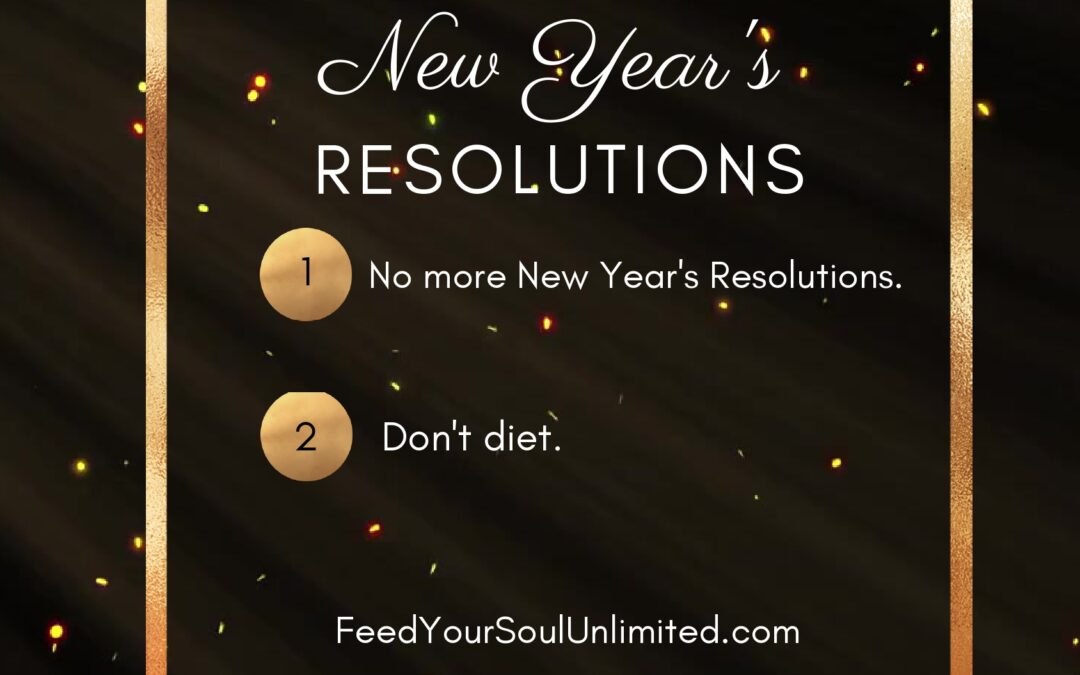
It is time to end dieting as a New Year’s Resolution. I know that contradicts what you normally hear this time of year.
We have bought into the idea that we need to diet (restrict) come the first of the year. Start dieting and exercise are the top 2 resolutions AND the top 2 failed resolutions.
When we look at New Year’s resolutions, consider that there is this cultural norm, this really kind of shared idea, at least in the United States.
I have noticed every January the gym becomes packed with people starting their dieting. I also remember the diet facilities I attended would be packed with people come January 1.
Come March 1 it would be back to normal. I have read statistics that only 9% of people keep their New Year’s Resolution.
Why don’t New Year’s Resolutions work?
First, they’re based on what you think you should do. There is this socially accepted idea that at the beginning of the year you should have a resolution.
Second is they make you want what you don’t have. Focusing on what we don’t have (thinner body) and what we lack, then that’s what shows up is things that we don’t have and the things that we lack.
Third, New Year’s Resolutions are poorly worded and unattainable.
Lastly, resolutions look for an easy answer. It looks for just kind of what’s the simple thing or what’s the kind of “easy.” There is no easy way to make changes. Going on a diet is not easy and it is not long-term successful.
It is not surprising that dieting at the new year is the most common New Year’s Resolution. We overeat and indulge over the holidays and then “pay the price for it” by dieting come January 1. It is a process of feast and famine.
We were “bad” over the holidays and need to be “good” at the start of the year. This process engages us in the cycle of diet/restrict- binge/overeat- shame/feel bad about ourselves. We are setting ourselves up to eventually overeat.
A part of the problem is the diet industry itself.
The diet industry is a multibillion-dollar industry. I have read different statistics of the money they make, and it is $58 Billion and above and the money they make increases ever year.
The diet industry is a failed industry. They make money because we do not lose weight and keep it off. We have all bought into the idea that if we just found the right diet or did it correctly, we would be thin.
We think that we are not ok. We need to be “healthy” and that is only be being thinner. If we were thinner, we would be healthy, attractive, in partnership, and I could go on and on.
Over the long term 80 to 95% of diets fail whereby the person gains back the weight and then some. I and people I know have experienced exactly this.
We have learned that if we gain back the weight, which is a product of dieting (diet/binge/shame cycle) we need to find the next diet. We are told and tell ourselves it is our fault. We have taken on this shame message that we are at fault. Remember the diet industry makes money off us feeling bad and unworthy.
Here are some ideas for a different plan rather than dieting.
Listen to your body’s needs.
- What is it your body wants? Using Intuitive Eating we focus on getting back in touch with your body and what it needs.
- What is your body asking for? Is it asking for sleep? Is asking for water? Or is it time to take a walk, get some movement in? Is it time to have conversations and get some kind of camaraderie going on? Give your body what it needs.
- Listen to your body’s physical hunger. Notice what it feels like to be physically hungry and satisfied. You might not know, yet, what it feels like to be gently hungry and satisfied.
The ideas about food, dieting and New Year’s Resolutions might be new for you. Just take them in. It might be hard to consider some or try all of the ideas presented here. Take a deep breath and see which idea you might like to look at first. You are worthy of being supported in this process and allow yourself to look at your relationship to dieting.
Kim McLaughlin, MA is a Psychotherapist, Speaker, Author, and Coach who specializes in working with people who suffer from binge eating and emotional eating. She is a Certified Intuitive Eating Counselor. She is the author of the best-selling book Feed Your Soul Nourish Your Life! A Six Step System to Peace with Food and the Amazon #1 Best Selling book Discovery Your Inspiration.
You can find Kim on her podcast Feed Your Soul with Kim and you can find it on all podcast platforms.
Wondering if you are an emotional eater? Sign up for the free Am I an Emotional Eater Quiz.
by KimMcLaughlin | Feb 10, 2020 | Podcast, Uncategorized
Could you use more happiness? Is there actually a way to be happier? In Gretchen Rubin’s book, The Happiness Project, she challenges us to look at happiness and see what we can do to boost it. Gretchen engages her readers in different concepts each month to build a stronger foundation of happiness.
This week we are looking at finding happiness for the month of February and we are focusing on love. You do not have to be in a marriage or intimate relationship to listen to this podcast, because we cover all forms of relationships: work, home, school, neighborhood and friendships.
Her happiness project is fun and helps us explore the idea of happiness and how to increase it.
Join us on the Feed Your Soul with Kim Podcast as we discuss:
- How can happiness feed our soul?
- Discover 5 ways to increase your happiness now.
- Learn how love increases your happiness.
Here is a link to the Subjective Happiness Scale we discussed in the Podcast. https://sonjalyubomirsky.com/subjective-happiness-scale-shs/
Kim McLaughlin M.A. is a counselor and a motivational coach working with people who engage in emotional eating or binge eating. She is a Certified Intuitive Eating Counselor. If you are in need of services contact Kim McLaughlin here.
Kim is the author of the best-selling book Feed Your Soul; Nourish Your Life! A Six Step System to Peace with Food. Learn more about her book here.
Kim McLaughlin has been identified as writing one of the Top 50 Blogs about Emotional Eating by the Institute on Emotional Eating. Sign up for her free Special Report: Top Strategies to End Binge Eating here or visit her website at www.FeedYourSoulTherapy.com.
by KimMcLaughlin | Feb 3, 2020 | Podcast, Uncategorized
I had the pleasure of being interviewed by my friend Michelle Warnica, on her New You for a New Decade Summit. I talked about my story with food, dieting and mindset. This conversation is a must listen to for a greater understanding about emotional eating, intuitive eating and feeding your soul. I think you will find our conversation interesting and I love Michelle’s questions to help us look at food differently.
I found myself sharing a lot of stories about my history with food and dieting that will, I think, resonate with you. We discuss how life is too short to eat crappy food. In addition, we have many suggestions for entering into intuitive eating.
Join us on the Feed Your Soul with Kim Podcast as we discuss:
- 3 ways intuitive eating has changed my life (and could change yours).
- What happens after intuitive eating?
- 4 things to do NOW if you are struggling with your weight.
- Learn what I do to feed my soul.
Kim McLaughlin, LMFT, psychotherapist, speaker, author, and host of the Feed Your Soul with Kim podcast. Kim helps high-achieving women improve their mental health, overcome emotional eating and binge eating, reduce anxiety, and create more joy and fulfillment in their lives. She offers online therapy throughout California and in-person counseling in Roseville, CA.
Schedule a free 20-minute consultation here. https://kim-mclaughlin.clientsecure.me/
by KimMcLaughlin | Jan 2, 2020 | Podcast, Uncategorized
At the end of every year I like to reflect and consider what has happened during the previous year. I get excited to spend some private time looking at my calendar, my journal and pictures to piece together my take away for the year. Each year’s reflection looks different and this year is no exception. Some years I write long journal entries about the previous year or I reflect in my mind or with a trusted friend about what I saw as the ups and downs of my life. No matter which method I chose I like to end the year considering what worked and what didn’t. This reflection of the previous year can focus on several aspects of my life or a few. Some areas of my life I explore are:
- Self
- Family/Friends
- Work/Education
- Creative
- Spiritual
- Home
- Money/Finances
I examine each of these areas and determine if there is something that I need to release and change so I don’t continue it into the New Year. Or I see if there is an area that I want to focus and do more of in the New Year. Ending the old year in this way gives me the ability to start new in the next year. For me, this is a time to start fresh. When considering what the past year has meant you could think about these questions:
- What was the general theme for this past year?
- If you use one to three words to guide your year, as I do- what happened?
- If you made a Vision Board, what has changed? What is the same?
- What was positive during the year?
- What was difficult during the year?
- Is there anything to be released?
- Is there a word that reflects what you want to bring into the New Year?
Using the above questions can be helpful at the end the year, so you can get some perspective regarding where you are now and for preparing a foundation for something new ahead.
I am excited for the potential of this New Year and hope you are too. How do you plan to let go of the old year? Let us know below.
In this podcast we discuss:
- Why is a decade in review important?
- What are 7 questions you need to ask yourself to review the last 10 years?
- Learn 4 ways to jog your memory to do a decade in review.
- Get into action by downloading my eBook with your tips to a successful Decade in Review.
Schedule time NOW to talk with me about what you are struggling with so you can move into peace. I have a limited number of times available till the end of the year. Signup here: https://feedyoursoulunlimited.com/free-breakthrough-session/
Discover a new way of increasing your satisfaction over the holidays by joining the Feed Your Soul Community. Join for free: https://www.facebook.com/groups/1172488142887200/
“Feed Your Soul; Nourish Your Life! The Six Step System to Peace with Food” is available. Get it now: https://feedyoursoulunlimited.com/fysnylbook/
Be sure to get your freebie – “Top Tips to End Emotional Eating” at
www.FeedYourSoulUnlimited.com
Want more information? You can find out more about Kim McLaughlin at www.FeedYourSoulUnlimited.com
We would love to get your feedback on this episode and know what you’d like to hear on upcoming shows. Email us at Info@FeedYourSoulUnlimited.com
Subscribe to my YouTube Channel to get the weekly podcast.
https://www.youtube.com/channel/UCTuSnNrSDhLvbhxoTMXZgog
If you enjoyed this podcast, please leave a review for others to find us and share this podcast with a friend.
Kim McLaughlin M.A. is a counselor and a motivational coach working with people who engage in emotional eating or binge eating. She is a Certified Intuitive Eating Counselor. If you are in need of services contact Kim McLaughlin here.
Kim is the author of the best-selling book Feed Your Soul; Nourish Your Life! A Six Step System to Peace with Food. Learn more about her book here.
Kim McLaughlin has been identified as writing one of the Top 50 Blogs about Emotional Eating by the Institute on Emotional Eating. Sign up for her free Special Report: Top Strategies to End Binge Eating here or visit her website at www.FeedYourSoulTherapy.com.
by KimMcLaughlin | Dec 19, 2019 | Podcast, Uncategorized
Recently, I have been asked repeatedly if I am done with holiday shopping. Well as a matter of fact, I am pretty much done. I used to be the person who engaged in “last minute shopping.” Truthfully you could find me Christmas Eve or sometimes Christmas Day (hello Walgreens) at the store shopping. I never even considered this as “last minute.” What I did not realize was, I was scrambling to get it done on the 24th and 25th. If I am going to be truthful, I was stressed. I have found that when I plan better in my holiday shopping AND my life, I feel calmer.
This holiday, I am on the search for peace: inner peace and peace around me. I am planning in a way that is not overly scheduled, but is honoring of what I and my family want do. This year my plan is also including rest and relaxation.
In this episode we look at holiday hungers. Why are we so interested in all of those holiday foods and they seem to call our name? You can feel empowered around food, shopping and other people.
In this podcast we discuss:
- What are the 4 Holiday Hungers?
- Learn about 7 emotional triggers and what you can do about them.
- Get into action with 5 different ideas to end Holiday Hungers.
Schedule time NOW to talk with me about what you are struggling with so you can move into peace. I have a limited number of times available till the end of the year. Signup here: https://feedyoursoulunlimited.com/free-breakthrough-session/
Discover a new way of increasing your satisfaction over the holidays by joining the Feed Your Soul Community. Join for free: https://www.facebook.com/groups/1172488142887200/
“Feed Your Soul; Nourish Your Life! The Six Step System to Peace with Food” is available. Get it now: https://feedyoursoulunlimited.com/fysnylbook/
Be sure to get your freebie – “Top Tips to End Emotional Eating” at
www.FeedYourSoulUnlimited.com
Want more information? You can find out more about Kim McLaughlin at www.FeedYourSoulUnlimited.com
We would love to get your feedback on this episode and know what you’d like to hear on upcoming shows. Email us at Info@FeedYourSoulUnlimited.com
Subscribe to my YouTube Channel to get the weekly podcast.
https://www.youtube.com/channel/UCTuSnNrSDhLvbhxoTMXZgog
If you enjoyed this podcast, please leave a review for others to find us and share this podcast with a friend.
Kim McLaughlin M.A. is a counselor and a motivational coach working with people who engage in emotional eating or binge eating. She is a Certified Intuitive Eating Counselor. If you are in need of services contact Kim McLaughlin here.
Kim is the author of the best-selling book Feed Your Soul; Nourish Your Life! A Six Step System to Peace with Food. Learn more about her book here.
Kim McLaughlin has been identified as writing one of the Top 50 Blogs about Emotional Eating by the Institute on Emotional Eating. Sign up for her free Special Report: Top Strategies to End Binge Eating here or visit her website at www.FeedYourSoulTherapy.com.





 Kim McLaughlin, LMFT, psychotherapist, speaker, author, and host of the Feed Your Soul with Kim podcast. Kim helps high-achieving women improve their mental health, overcome emotional eating and binge eating, reduce anxiety, and create more joy and fulfillment in their lives. She offers online therapy throughout California and in-person counseling in Roseville, CA.