by KimMcLaughlin | Nov 26, 2025 | Holidays, Intuitive Eating
Can You Really Be an Intuitive Eater at Thanksgiving?
Thanksgiving and intuitive eating might seem like an unlikely pair. Thanksgiving is known for overflowing plates, endless choices, and the cultural expectation to overeat. Intuitive eating, however, is about listening to your body, honoring hunger and fullness, and approaching food with peace (not pressure).
But here’s the truth:
You can be an intuitive eater at Thanksgiving.
I’ve practiced intuitive eating for years, and I’ve supported clients who successfully enjoy the holiday without guilt, restriction, or bingeing.
If I can do it, so can you.
Why This Season Feels So Hard: The Holiday Trifecta
I call the stretch from October 1 to December 31 the Holiday Trifecta. It’s three full months of parties, sweets, special foods, and pressure to “let loose” with eating, paired with an equally strong expectation to diet/lose weight come January.
This is the binge-restrict cycle, and it isn’t a personal failure. It is a version of our culture that shames you for eating. The holidays amplify this message.
Here’s what happens…
Dieting and restricting throughout the year often lead to overeating during special occasions (any holiday). When we limit foods, they become more tempting. When they eventually show up again—like holiday meals—we naturally want more. This is not a lack of willpower. It’s the predictable backlash of restriction.
Halloween, Thanksgiving and Christmas are one month after the other, which creates a lot of pressure around food. The pressure continues with social and familial expectations.
Intuitive eating offers a different path.
How to Be an Intuitive Eater at Thanksgiving
Here are the practices that support me (and my clients) in feeling grounded, peaceful, and connected at holiday meals:
1. Spend part of the day with movement that feels good
This year I am going to a morning yoga class. Other years, my family participated in a local turkey trot or taking a long walk. It isn’t about earning food or burning calories, it’s simply enjoyable activities. Movement can be part of your holiday if it feels nourishing, not punishing.
I enjoy taking a walk after the Thanksgiving meal. It is a great way to get out of the house and get centered.
2. Eat regular meals all day and don’t “save up” for the Thanksgiving meal
One of the biggest mistakes I see people do is not eat all day, so they can “earn” a big meal later. This can lead you to feeling overly hungry, which is a set up for overeating.
On Thanksgiving day, I eat breakfast and lunch just like any other day. When I arrive at the Thanksgiving table, I’m neither starving nor planning to tightly control myself. I choose foods I genuinely want, serve a portion that feels satisfying, and remind myself I can always go back for more.
And you know what?
After years of intuitive eating, I usually find that my first plate is enough.
3. Tune into Hunger and Fullness
Before eating, I check in with my body:
- Am I hungry and how hungry am I?
- What sounds satisfying?
- How will this food make me feel?
Pay attention to both hunger cues and satiety (fullness) cues. Stopping when I’m comfortably full—not stuffed, not deprived. Listening to my body is a skill, and Thanksgiving is a great time to practice.
I have learned that feeling stuffed afterwards is not an enjoyable physical feeling, so I do what I can to avoid it.
4. Care for your emotions
Food isn’t the only challenge at Thanksgiving. Emotions can run high: family dynamics, stress, overstimulation, or expectations can be overwhelming.
I always create a plan to address my emotions ahead of time. My plan often involves:
- Taking a short walk
- Switching conversations
- Taking a few deep breaths
- Stepping outside for quiet
- Finding someone supportive to chat with
Emotional care helps prevent turning to food as the only coping tool.
Think about what you may need emotionally this year and give yourself permission to honor those needs.
Holiday Foods Aren’t Special-Unless We Make Them Special
A big driver of holiday overeating is the belief that certain foods are only available once a year. Marketers fuel this idea with seasonal items (hello, Pumpkin Spice Latte) that create a sense of scarcity.
But here’s the truth:
Most Thanksgiving foods are available year-round.
We could make turkey or pies in March if we wanted. I used to think that mashed potatoes are only available during the holidays. We began to have the more often, because we like them.
When we allow ourselves year-round access to the foods we love, something powerful happens:
habituation.
When we are freely offered food anytime of the year, it is not this irresistible food anymore. We are then less likely to overeat it.
This is why intuitive eating works so well during the holidays, food is never forbidden, and you’re not entering the season from a place of deprivation.
Societal and Cultural Messages About Holiday Eating
These messages are everywhere at this time of year, and they keep us stuck in the binge/restrict cycle:
1. You must exercise to “earn” your meal.
How many times have you heard someone say, I’m going to the Turkey Trot this morning, so I can eat our Thanksgiving meal. This reinforces punishment-based movement and disconnects you from your body. A lot of people I work with do not exercise because it has been seen as punishment for eating.
2. Plan your plate by calories, points, or macros.
Diet culture tells us to pre-decide what we “should” eat. Intuitive eating allows you to choose what you want in the moment. I remember being on a diet where the instructor told us the week before to plan what we would eat on Thanksgiving. I found this was an impossible task. I now know that I go from an intuitive eating mindset and chose in the moment what will work for me.
Granted, there might be a certain style of eating that fuels your body better, do what fits you!
3. Restrict all week so you can indulge on Thanksgiving.
I used to hear this in from diet gurus who said we should eat less during the week so we can eat more at Thanksgiving. This is a setup for overeating, shame, guilt and binging. You deserve to have the right amount of food all week, regardless of what you eat at a holiday meal.
4. “Eat as much as you can—it’s the only time you get this food!”
Overeating is increased by the scarcity mindset. Truthfully, holiday foods are generally always available. In my area we can get foods at most times of the year OR we can freeze foods to eat later. Part of what makes holidays so special is the foods that taste so good and can remind us of our past.
5. Expect to feel physically sick afterward.
NO, it is not normal to expect to feel sick after you eat. I like to have what I want and tell myself; I can have more later. Planning to feel uncomfortable in your body (overfull) is not a loving way to treat yourself.
I encourage you to lean into honoring your bodies needs no matter what holiday it is.
6. Feel guilty because you ate too much.
Sometimes we eat too much for any number of reasons. This is the time to be kind to yourself and lean into more self-love. One of my core principles is to embrace more self-love.
7. Make low-fat or low-calorie versions of your favorite treat.
Ugh, on a holiday I do like the version that tastes the best- not the one that is the lowest calorie. We want to feel satisfied after the meal, which supports our body’s needs.
What If You Ate Intuitively All Year Long?
Eating on Thanksgiving is no different from eating later in the year. Intuitive eating can be the goal for each meal.
Your body doesn’t change its needs because it is a holiday.
Intuitive eating helps you approach every meal with the same mindset: centered, calm, and connected.
Here are some good Intuitive Eating questions to ask yourself…
- What would it feel like to eat intuitively 365 days a year?
- How can I drop the holiday panic and the January guilt?
- When do I trust my body to tell me what it needs?
If I can do this, you can do this. This is possible for you.
Consider what your next step could be?
Think about one way you could bring intuitive eating into your Thanksgiving this year.
It might be:
- Eating breakfast
- Serving yourself what you actually want
- Stopping when you’re satisfied
- Caring for your emotions
- Taking a calming breath before you plate your food
You don’t have to overhaul everything all at once; just small shifts create big peace.
I wish you a holiday filled with food freedom, emotional ease, and deep connection with your body.
You deserve all of this and MORE!!!
Kim McLaughlin, LMFT, psychotherapist, speaker, author, and host of the Feed Your Soul with Kim podcast. Kim helps high-achieving women improve their mental health, overcome emotional eating and binge eating, reduce anxiety, and create more joy and fulfillment in their lives. She offers online therapy throughout California and in-person counseling in Roseville, CA.
Schedule a free 20-minute consultation here. https://kim-mclaughlin.clientsecure.me/
by KimMcLaughlin | Dec 17, 2024 | Eating Disorders, Holidays
Holiday survival skills are in demand as we navigate the busy and often stressful season.
Popular strategies being shared this year focus on maintaining physical health, managing emotions, and balancing social dynamics:
There are a lot of stressors whether you feel busy or not.
First, when we look at how to survive over the holidays determine how you will take care of your body.
Everyone knows it is important to take care of your body and that it can become complicated over the holiday season.
Here are some strategies to take care of your body this holiday season.
- Stay active in a way that works for you. Since it is the time of year when it is darker earlier, consider what activities you need to keep your body feeling good.
- Eat foodsthat work with your body. I like asking the question, what is your right food. Wonder to yourself if this food will give you the energy to do the things you need to do.
- Notice if you tend to try to restrict what you want to eat. This restriction can have the opposite effect and lead you towards binge eating. Recognizing there are special foods for this time of year can help you have the holiday foods that you want to have.
- Are you sleeping well or enough? Sleep is critical to your overall health. This time of year, we can have a varied sleep schedule due to activities. Look at how you can get your right amount of sleep.
Second, making sure you are focused on YOUR mental health and emotional wellness is a key to holiday survival.
The busy atmosphere can make us tend to override our mental health and emotional needs.
Try some strategies to help with keeping your emotional needs in mind.
- Acknowledging and addressing holiday-specific challenges, such as loneliness, grief, or dealing with family conflicts, can help maintain emotional well-being. These emotions can take a hold of us and affect how to maintain our balance.
- Try techniques like setting boundaries, practicing gratitude, or taking some space from others when you feel out of balance.
- If you feel too overwhelmed, seeking therapy can be helpful. Look for a qualified mental health therapist to help you if you are feeling down.
Third, evaluate what stress management skills you need for yourself this holiday season.
Here are some key tools to distress.
- Is your schedule overloaded? Try decluttering your schedule. What is your intention for this holiday season? What do YOU want to accomplish: rest, connecting with special people, taking a trip, or being active are some of the questions you can ask yourself.
- Evaluating what you need to let go of in your schedule can be valuable. You have permission to say no to people and activities that do not serve you this holiday.
- Prioritize your self-care can be life affirming. Ask yourself the question, what would bring me peace. What do you need to do for YOU? I ask myself these questions to help me practice more self-care.
- What is it you would like to do? Do you have a list of what you want to do this holiday season? I like using my Holiday Bucket list to determine my priorities
I write out my Holiday Bucket List every year. This is my list of what I want to do over the holiday season.
What are the things this holiday that you want to do? Here are some questions to guide you in the right direction.
- What foods you want to have?
- What foods do you want to make?
- What kind of activities would you like to do?
- Where would you like to go?
- What decorations do you want to put up.
- Do you desire some rest or more activities?
- What are crafts/decorating that bring you joy.
- Where would you like to go over this holiday season?
- What does this season mean to you and how can you embrace that?
- What are your spiritual needs? What can you do to support your spiritual needs.
I find it is helpful to take my list and put it in on my calendar.
Lastly look at the social and family dynamics playing out around you.
Determine what YOU need for yourself and preparing to ask for what you need can be critical.
- If you must manage challenging conversations- this can be the time to practice boundaries. I like coming up with my plan before the difficult conversation happens.
- Navigating differing values within families can be a concern over the holidays. It can be helpful to prepare your response to intrusive questions.
- I like planning neutral; inclusive activities can make gatherings smoother and there is less time for inappropriate statements from others.
- I like to pivot the conversation away from challenging topics, so I have some non-controversial topics prepared: weather, vacations, or sports.
- Being prepared to say, I don’t want to talk about this, is valuable. You can practice what you will say in advance. I like to ask the person bringing up a controversial topic- Why are you bringing this up? What is your intention? This helps you understand where they are coming from and set some limits.
- Who do you really want to spend time with? Who are the right people to spend time with? You deserve to spend time with people that are pleasant and enjoyable.
I encourage you to set yourself up for success. You are worthy of an enjoyable holiday.
Make this your time to connect with yourself and others that you truly care about.
Check out the Feed Your Soul with Kim Podcast where we talk about Holiday Survival Skills.
Kim McLaughlin, MA is a Psychotherapist, Speaker, Author, and Coach who specializes in working with people who suffer from binge eating and emotional eating. She is a Certified Intuitive Eating Counselor. She is the author of the best-selling book Feed Your Soul Nourish Your Life! A Six Step System to Peace with Food and the Amazon #1 Best Selling book Discovery Your Inspiration.
You can find Kim on her podcast Feed Your Soul with Kim and you can find it on all podcast platforms.
Wondering if you are an emotional eater? Sign up for the free Am I an Emotional Eater Quiz.
by KimMcLaughlin | Oct 31, 2024 | Binge eating, Holidays
Halloween used to be a tricky time for me, because of all the candy. I was always afraid I would overeat, gain weight and hate myself for it.
The aisles of colorful candy were hard for me to ignore, and my strategies for “managing” my candy intake became more elaborate each year.
If you’ve ever struggled with balancing holiday treats and Halloween candy, my story might sound familiar.
I transformed my mindset around candy—and you can too.
For years, I cycled through various strategies to avoid Halloween candy temptations:
- I bought candy and tried not to eat it!!!
The tactic of not buying candy never worked as planned! I’d buy a stash and vow to leave it alone until Halloween. Inevitably, I’d sneak a piece here and there until I had to replenish it. I would constantly think about the candy and feel compelled to eat it.
- I tried not buying candy at all.
My next strategy was to avoid buying it altogether. This strategy worked, because it was not in my house. I felt uncomfortable because I was avoiding dealing with candy. I wanted to feel comfortable with candy around AND not eat it all.
- Avoiding Trick-or-Treaters was one of my interesting plans.
For years I would go to the gym on Halloween night to avoid being home when trick-or-treaters came by. If I got home while they were still out, I would hide in my bedroom and keep all the lights off. I feared Halloween for all of the wrong reasons.
- Escaping to a Friend’s House
Some years. I would go to my friend’s house for the night to skip the candy stress. I thought if I just avoided the candy, I would be ok.
My husband LOVES to give out Halloween Candy.
I realized while I was dating my husband that he loves giving out Halloween candy to neighborhood kids.
Since he gave out candy and it was in the house, I realized I needed to come up with a different plan.
Next, when my daughter arrived, I knew it was time for a real change.
I found Intuitive Eating is the key component to heal my relationship with Halloween Candy.
Intuitive Eating showed me that food doesn’t have to be the enemy. I didn’t have to “manage” or “control” candy or any other foods. This idea was incredibly freeing, though it took some time to fully embrace.
Key Lessons in My Food Freedom Journey
There some components to help you understand how to use Intuitive Eating.
First, candy isn’t the enemy.
Realizing that there are no “bad” foods—even candy—was huge for me. Halloween candy wasn’t going to harm me, and I didn’t need to label it as something forbidden. When I take candy off of the “bad” list, it does not have power over me.
Second, fear and candy don’t have to go together.
Candy used to scare me because I feared losing control, gaining weight, or somehow “failing” my health goals. By letting go of these fears, I allowed myself to see candy as just candy. If I feel the fear, I focus on dealing with the fear NOT the candy.
Third, allowing myself to enjoy Halloween Candy.
Since I give myself permission to eat candy whenever I felt like it, removed its power over me. It was no longer a “special” or “forbidden” treat. It was just a choice, like any other. I have allowed myself to have candy throughout the year and it is not something special to be binged on at Halloween.
How you can begin your Own Journey Toward Candy Freedom???
If you’re working to make peace with candy (or any food), try these steps:
1. Challenge your thoughts about Halloween candy.
You can reflect on why candy feels scary.
- Are you worried about weight gain?
- Concerned about feeling out of control?
- Do you fear “unhealthy” eating?
I like to notice the emotions and thoughts that come up and journal about them. Through the journalling process, I can determine what the feels really mean to me. Once I can see/feel the feelings and determine what I need, then candy is not all powerful.
2. Explore your beliefs around candy
- What messages have you received about candy?
- Do you associate it with guilt?
- Question where these ideas came from and whether they still serve you.
As you explore your beliefs about candy you can see if they are true or not.
If you were approaching candy with kindness rather than fear, what would that look like? Remember, self-restriction doesn’t work in the long term. True balance means allowing yourself to have candy without guilt.
When you choose to eat candy, do it mindfully.
- Savor the taste of the candy.
- Enjoy the experience of the Halloween candy.
- Do you like the taste?
- Is there a point where it does not taste good anymore?
You might find that, over time, candy becomes far less of a big deal.
Now, I happily give out candy to our neighborhood kids. When my daughter returns with her Halloween haul, I can share a piece without the slightest worry.
Candy is just another food, and Halloween is just one day.
If you’re tired of feeling out of control around candy, know that there’s hope. You, too, can find food freedom. By rethinking your relationship with candy, you can make Halloween (and every day) a little sweeter. 🎃🍬
Kim McLaughlin, MA is a Psychotherapist, Speaker, Author, and Coach who specializes in working with people who suffer from binge eating and emotional eating. She is a Certified Intuitive Eating Counselor. She is the author of the best-selling book Feed Your Soul Nourish Your Life! A Six Step System to Peace with Food and the Amazon #1 Best Selling book Discovery Your Inspiration.
You can find Kim on her podcast Feed Your Soul with Kim and you can find it on all podcast platforms.
Wondering if you are an emotional eater? Sign up for the free Am I an Emotional Eater Quiz.
by KimMcLaughlin | Jan 13, 2023 | Holidays, Lifestyle, Uncategorized
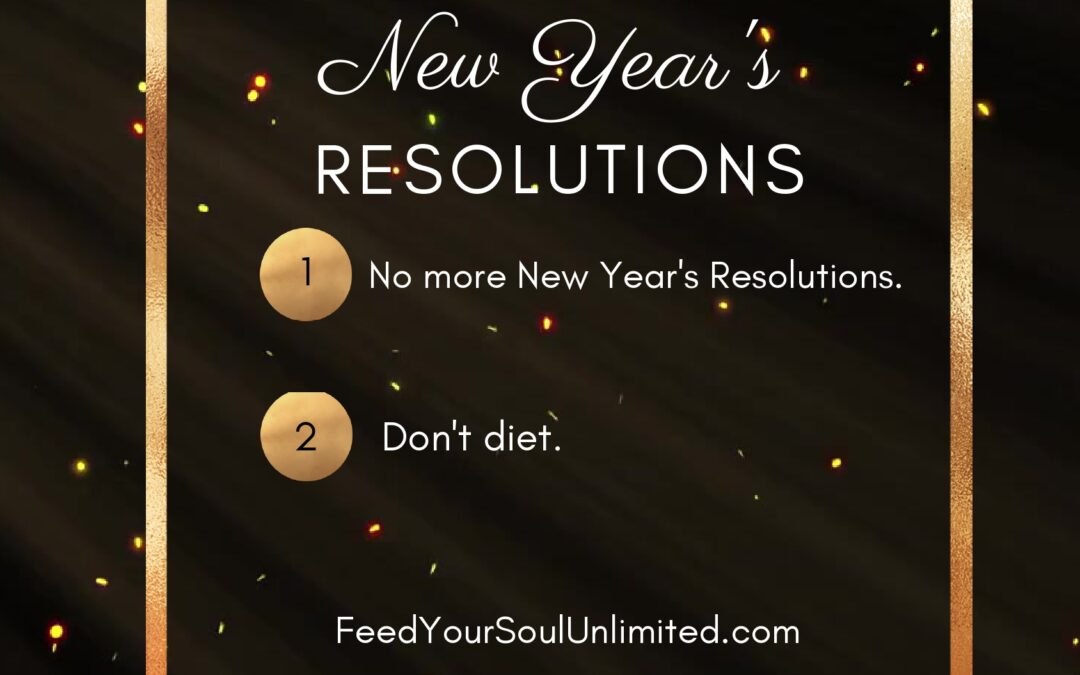
It is time to end dieting as a New Year’s Resolution. I know that contradicts what you normally hear this time of year.
We have bought into the idea that we need to diet (restrict) come the first of the year. Start dieting and exercise are the top 2 resolutions AND the top 2 failed resolutions.
When we look at New Year’s resolutions, consider that there is this cultural norm, this really kind of shared idea, at least in the United States.
I have noticed every January the gym becomes packed with people starting their dieting. I also remember the diet facilities I attended would be packed with people come January 1.
Come March 1 it would be back to normal. I have read statistics that only 9% of people keep their New Year’s Resolution.
Why don’t New Year’s Resolutions work?
First, they’re based on what you think you should do. There is this socially accepted idea that at the beginning of the year you should have a resolution.
Second is they make you want what you don’t have. Focusing on what we don’t have (thinner body) and what we lack, then that’s what shows up is things that we don’t have and the things that we lack.
Third, New Year’s Resolutions are poorly worded and unattainable.
Lastly, resolutions look for an easy answer. It looks for just kind of what’s the simple thing or what’s the kind of “easy.” There is no easy way to make changes. Going on a diet is not easy and it is not long-term successful.
It is not surprising that dieting at the new year is the most common New Year’s Resolution. We overeat and indulge over the holidays and then “pay the price for it” by dieting come January 1. It is a process of feast and famine.
We were “bad” over the holidays and need to be “good” at the start of the year. This process engages us in the cycle of diet/restrict- binge/overeat- shame/feel bad about ourselves. We are setting ourselves up to eventually overeat.
A part of the problem is the diet industry itself.
The diet industry is a multibillion-dollar industry. I have read different statistics of the money they make, and it is $58 Billion and above and the money they make increases ever year.
The diet industry is a failed industry. They make money because we do not lose weight and keep it off. We have all bought into the idea that if we just found the right diet or did it correctly, we would be thin.
We think that we are not ok. We need to be “healthy” and that is only be being thinner. If we were thinner, we would be healthy, attractive, in partnership, and I could go on and on.
Over the long term 80 to 95% of diets fail whereby the person gains back the weight and then some. I and people I know have experienced exactly this.
We have learned that if we gain back the weight, which is a product of dieting (diet/binge/shame cycle) we need to find the next diet. We are told and tell ourselves it is our fault. We have taken on this shame message that we are at fault. Remember the diet industry makes money off us feeling bad and unworthy.
Here are some ideas for a different plan rather than dieting.
Listen to your body’s needs.
- What is it your body wants? Using Intuitive Eating we focus on getting back in touch with your body and what it needs.
- What is your body asking for? Is it asking for sleep? Is asking for water? Or is it time to take a walk, get some movement in? Is it time to have conversations and get some kind of camaraderie going on? Give your body what it needs.
- Listen to your body’s physical hunger. Notice what it feels like to be physically hungry and satisfied. You might not know, yet, what it feels like to be gently hungry and satisfied.
The ideas about food, dieting and New Year’s Resolutions might be new for you. Just take them in. It might be hard to consider some or try all of the ideas presented here. Take a deep breath and see which idea you might like to look at first. You are worthy of being supported in this process and allow yourself to look at your relationship to dieting.
Kim McLaughlin, MA is a Psychotherapist, Speaker, Author, and Coach who specializes in working with people who suffer from binge eating and emotional eating. She is a Certified Intuitive Eating Counselor. She is the author of the best-selling book Feed Your Soul Nourish Your Life! A Six Step System to Peace with Food and the Amazon #1 Best Selling book Discovery Your Inspiration.
You can find Kim on her podcast Feed Your Soul with Kim and you can find it on all podcast platforms.
Wondering if you are an emotional eater? Sign up for the free Am I an Emotional Eater Quiz.
by KimMcLaughlin | Dec 21, 2022 | Holidays
Surviving seems to be the goal over the holidays. Seeing if we can just make it through the holidays and get to the end is the goal.
Getting to the place of thriving over the holidays can seem unattainable. Thriving can seem unreachable, because of all we have come to believe we must DO each holiday season.
How about imaging thriving as the goal? What would that look like?
- Slowing down.
- Be Mindful.
- Spend money in a reasonable manner.
- Use your time in a way that is enlivening.
I have been imagining (and practicing) how I can thrive this holiday.
Let’s start by looking at how is stress and overwhelm is showing up for you.
- Start by identifying what the overwhelm looks like.
Some helpful ways to connect with overwhelm is to journal and meditate. Get quiet to see how the stress and overwhelm are showing up for you.
- Are you responding to others’ expectations of you?
You might be feeling the need to always say yes. Thinking this is tradition. This is “what we always do.” Expectations can be overwhelming.
- Are you feeling scared about being around food?
Wondering how much food will there be? Will I eat too much? Will I be judged. Will I drink too much?
- Are you feeling bad about your body and how you look.
Feeling afraid others will notice your size and comment on it or disapprove of it? Or you just do not feel comfortable in your own skin.
- How is stress showing up in your body?
Stress can show up as sickness or feeling physically bad.
- Are you feeling fearful of not having enough time or money.
Time and money are limited resources and this time of year we think we have more than we actually do.
Money can become a problem when we rely on credit cards to pay, and we go into debt. Time becomes a problem when we do not plan well and become reactive.
Next, make a plan to manage the stress.
- A great technique is to ask yourself, “What is the stress and overwhelm trying to tell me?”
The feelings are informative and can provide a guidepost if you let it. Then sink into the question, “What do I really want?”
I recently became sick, and I asked my body what it was trying to tell me. I realized I was too overscheduled, and my body was saying I needed to rest more. The sickness MADE me have to rest and I did.
- It can be helpful to plan to incorporate food into your holiday. Food can be a huge trigger this time of year.
A helpful strategy is to eat 3 meals a day. Eat what you normally eat. Don’t save up for the “big meal,” because this is a set up to restrict/binge/shame. When we do not eat regularly, our body thinks we are restricting, and it will lead you to crave food and overeat.
- You might wonder if you need to say no to sugary treats?
Not allowing yourself to have sugary treats can set you up to binge. If you deny what you want ultimately when emotions show up, you will have less resolve to not eat the sugary foods. Instead of denying yourself, allow yourself to have what you want. When you are eating regular meals and allowing yourself treats, there is less likelihood that you will binge. If you do binge, forgive yourself and move on. Being stuck in anger and resentment about overeating will NEVER lead to a change in behavior.
- Set limits on others AND yourself? Say no to what does not work for you.
This is the time of expectations other can have of us. What is it that you want to do? Do that!
Where is your NO to other people? What will you do, and won’t you do? I think it is a time to have more no’s than yes’. It is ok to say no to a past family tradition, if they are not what you want this year. Doing things for others because we think we have to leads to overwhelm and stress. Let’s do it differently this year.
Lastly, we tend to put expectations on ourselves. We think we need to bake, clean, buy, go out, etc. We think we need to maintain holiday traditions. Take a deep breath and determine if this still fits for you. Say no when you need to.
This holiday is an opportunity to thrive.
First, focus on what is right for you? Yes, you can be limited in the activities that you do. Time is a limited resource, use it wisely.
I have decided I want more rest and peace this holiday season. Being in front of the twinkling lights is thriving for me.
Second, coping strategies are really thriving strategies. Say no as you need to. Ask for what you want. Set your expectations on time and money. Eliminate the stressors. Take that internal check to see what stresses you and find a way to let go of the stressor.
Third, what is your reason for the season?
- What is this holiday about for you?
- What do you want to be, do, have after the holiday?
- What do you want to come away with after the holiday? Focus on making this happen.
My desire for this holiday is to experience more peace, light, joy, and love. My plans for this holiday are designed to meet that desired goal.
Lastly, be intentional about this holiday to get all the goodness out of it.
Kim McLaughlin, MA is a Psychotherapist, Speaker, Author, and Coach who specializes in working with people who suffer from binge eating and emotional eating. She is a Certified Intuitive Eating Counselor. She is the author of the best-selling book Feed Your Soul Nourish Your Life! A Six Step System to Peace with Food and the Amazon #1 Best Selling book Discovery Your Inspiration.
You can find Kim on her podcast Feed Your Soul with Kim and you can find it on all podcast platforms.
Wondering if you are an emotional eater? Sign up for the free Am I an Emotional Eater Quiz.
by KimMcLaughlin | Nov 24, 2022 | Holidays
If you look anywhere on the internet you will hear about the stress of the holidays. I wondered what you are think about stress over the holidays, so I asked.
I ran a survey asking:
Do you need strategies to support you with food and all the overwhelm this holiday season?
A whopping 86 percent said yes, they need strategies with food and all the overwhelm this holiday season. I was struck by how large the number was, 86%. It is not that you just have stress and overwhelm, but you do not know what to do about it!
That is a lot of people!
This stress and overwhelm can show up as:
- Loneliness
- Family drama
- Money problems
- Overeating
- Normal routines are gone, due to the increased activities
- Unreasonable expectations
Loneliness can be so devastating and unexpected at the holidays. There are movies and songs about being surrounded with others. What if you have been wronged by family members, they are not people you want to be with, or they simply live nowhere near you. You could be unhappy with people in your family, unwilling to see them, setting boundaries on them. Even with boundaries there can be loneliness. There is the expectation that we will want to be with family, but that might not be the case.
A strategy for loneliness is to be with someone. Who is someone you like or feel close to? Someone you might want to reach out and say hi to? Who is it you enjoy spending time with? Reach out to them. You might be surprised at their response.
Another strategy to curb loneliness is by spending time with a pet. This can be just the right opportunity to feel close without the expectations of others.
Family drama is very common. Do you feel you have to see family members you do not feel close to, do not feel connected to or maybe you just do not like them? There is the air of expectation that you want to be with people you are related. It is stressful and overwhelming to try to be around people you think you are supposed to be around.
A strategy to deal with family drama is to be gentle with yourself. You are the only one who knows what is right for you. When there is family drama it can be so helpful to set boundaries. If needed, say no to what you need to say no to. This is your life to live.
Money is a huge issue during the holidays. There are expectations we are supposed to buy things for others. You might feel the expectation to buy something out of your price range or you just don’t have the funds for it this year. That is super stressful.
A strategy is to focus on what you are grateful for. It quickly changes your heart and mindset to the positive. This will not bring you money, but it will change your attitude. Remember, there is no requirement that you need to buy things for others.
Overeating is another problem that leads to overwhelm and stress over the holidays. There are so many foods we do not have at other times of the year that are so inviting. We can either go all in and eat everything or say no I will not have any of it. This can become a feast or famine time of year. Often people decide to feast (overeat) during the holidays and famine (diet) at the new year. This leads to stress about weight, fullness, and self-loathing.
There are many strategies to deal with food in a productive way over the holidays.
First, notice what foods you really want and have them. Yummy foods are delicious and there are many seasonal items.
Second, go easy on yourself. There are so many emotions and mixed priorities during the holidays that stress increases.
Third, get support from people who do not focus on dieting. Get valuable tips and strategies to look at food differently. I would suggest that you join us in the Peace with Food over the holidays program (it is very affordable and supportive).
Normal routines are gone over the holidays. Travel, guests, and schedule changes create a different schedule than what you are used to. This increases stress in our bodies.
One strategy is to keep your bedtime routine as close to normal as possible. Good sleep is critical to end overeating and to keep stress and overwhelm down. This sounds like such a simple suggestion, but it really works!
Lastly, there are so many unreasonable expectations we put on ourselves or put on us by others. These expectations take us away from our needs and wants. Possibly you do not even know what you need or want.
A strategy is to take some time to determine what you want to do or be over the holidays and do that. In Peace with Food over the holidays program we talk about determining what you want to do. I call it a Holiday Bucket List. Determine what is right for you and do that. What is the most important thing for me to do?
Peace with Food Over the Holidays:
The holidays are full of stress and overwhelm. Kim has an easy online course designed to fit into your busy schedule and give you some quick wins to feel peaceful during the holidays. Check out Peace with Food over the holidays program. It is a low-cost high value program with quick lessons to get you on track and keep you on track over the holidays.
Kim McLaughlin, MA is a Psychotherapist, Speaker, Author, and Coach who specializes in working with people who suffer from binge eating and emotional eating. She is a Certified Intuitive Eating Counselor. She is the author of the best-selling book Feed Your Soul Nourish Your Life! A Six Step System to Peace with Food and the Amazon #1 Best Selling book Discovery Your Inspiration.
You can find Kim on her podcast Feed Your Soul with Kim and you can find it on all podcast platforms.
Wondering if you are an emotional eater? Sign up for the free Am I an Emotional Eater Quiz.






 Kim McLaughlin, LMFT, psychotherapist, speaker, author, and host of the Feed Your Soul with Kim podcast. Kim helps high-achieving women improve their mental health, overcome emotional eating and binge eating, reduce anxiety, and create more joy and fulfillment in their lives. She offers online therapy throughout California and in-person counseling in Roseville, CA.