Stop Struggling with Candy: Intuitive Eating Tips for the Holiday Season

Stop Struggling with Candy: Intuitive Eating Tips for the Holiday Season


Facebooktwitterpinterestlinkedinmail

I have so many memories of struggling with candy around the holidays.

When I was single, I feared having candy in the house. Every Halloween, I’d buy a bag of candy “for the trick-or-treaters,” but that was never how it went. I’d end up eating it all (every piece) then feel ashamed and out of control. I was convinced I couldn’t stop.

A “Solution” that didn’t solve the problemHoliday overeating and fear of candy

One year, I came up with a plan: I’d go to the gym on Halloween night.

If you’ve ever been to the gym on Halloween, you know it’s practically empty! But I thought that was the only way to avoid overeating candy. If I wasn’t home, I wouldn’t have to buy any candy—and therefore, I wouldn’t binge.

It worked in a way. I didn’t buy candy. But when I came home, I’d sneak into the house, turn off all the lights, and hide upstairs watching TV so no one would knock.

I felt ashamed to tell the kids I didn’t have candy—I just wanted to avoid the entire situation.

Then came a new perspective…

I married a man who loved giving out candy on Halloween.

He’d buy candy, keep it sealed until Halloween night, enjoy a few pieces, and take the rest to his office to share. Watching him do that amazed me. I saw how candy does not have to have control me. It was possible to have it in the house without obsessing over it.

At first, it still felt hard. I used to think, “You know you’re going to eat it—just do it.” I believed I had no control. Over time, that belief changed.

Learning About Intuitive Eating

Everything began to shift when I discovered Intuitive Eating. (link)

It took time and effort, but I learned how to have true freedom around food. Now, we can have candy in the house, and it doesn’t “call my name.” I can enjoy it when I want it—without guilt, fear, or overeating.

That peace didn’t happen overnight, but it’s possible.

Now I have Peace with Food Over the Holidays.

I’ve realized that peace with food isn’t just about managing food, it’s about addressing the whole picture. There are several key areas that help release the grip food and sweets can have on us:

  1. Physical

Learn simple, practical ways to look at food and candy differently. Small shifts can make a big difference.

  1. Emotional

The holidays can bring up strong emotions. Learning to handle them without turning to food is life changing.

  1. Mental

Those obsessive food thoughts can feel overwhelming. Building tools to manage them is essential.

  1. Lifestyle & Social

Setting boundaries and learning to say “no” can help you protect your peace during the holidays.

  1. Mindfulness

When life gets busy, how can you slow down and connect with yourself? Mindfulness helps you get quiet in the chaos.

  1. Self-Love

Ask yourself, What do I really need? When you treat yourself with love, your relationship with food naturally softens.

Why Restriction Doesn’t Work

Notice that only one of these six components is about food itself. That’s because food isn’t the real issue—restriction is.

When we restrict food, it only increases obsession and guilt. The real solution is creating balance among all the physical, emotional, and mental parts of our lives.

It takes effort and practice, but it truly works.

Finding real Peace with Food

Today, I happily hand out candy to our neighborhood kids. I don’t feel anxious when my daughter brings home her Halloween treats. I can enjoy a piece—and move on.

That’s peace with food, and you can have it too.

If you want to start now, here are some journaling questions to help you look at food, candy and Halloween differently:

  1. What have you been told about candy?
  2. Is there a fear of gaining weight from eating candy?
  3. Is there a need that you are not meeting?
  4. Do you allow yourself to have candy mindfully?
  5. What family memories do you have of candy?
  6. Did you get candy when you were good?
  7. Were you shamed of how your body looked?

Start by wondering what candy means to you. You might find some really insightful answers.

Wondering if you are an emotional eater? Sign up for the free Am I an Emotional Eater Quiz.

Disclaimer: This blog is not a replacement for mental health counseling. If you are suffering, seek out a qualified mental health provider. You are worth it!!!

Kim McLaughlin, LMFT, psychotherapist, speaker, author, and host of the Feed Your Soul with Kim podcast. Kim helps high-achieving women improve their mental health, overcome emotional eating and binge eating, reduce anxiety, and create more joy and fulfillment in their lives. She offers online therapy throughout California and in-person counseling in Roseville, CA.

Schedule a free 20-minute consultation here. https://kim-mclaughlin.clientsecure.me/
Can you have peace with food this holiday season?

Can you have peace with food this holiday season?

Facebooktwitterpinterestlinkedinmail

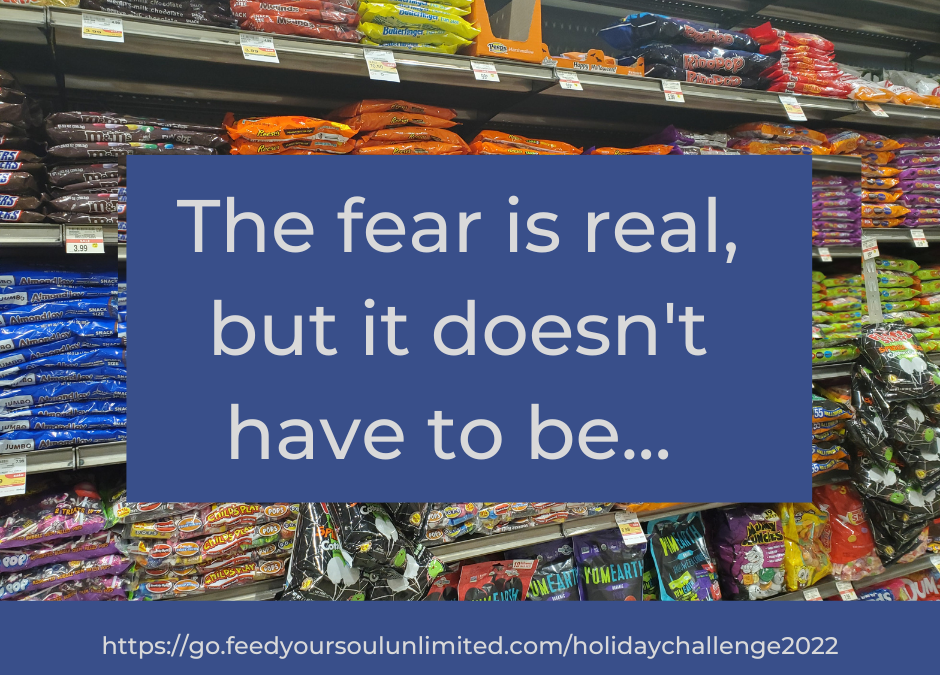
Do you find you are already thinking about candy? It is front and center in the grocery stores. I have already heard stories of people buying candy in September and eating all of it.

This is your opportunity to look at this holiday season, which I lovingly call the Holiday Trifecta, differently. The holiday trifecta is the time between October 1 and January 1 where we can be tempted by food. This is 3 months of pressure, stress and overwhelm.

Here are some ways to handle food over the holiday season:

  1. Don’t keep candy in the house?
  2. Think you won’t overeat during a holiday meal and then despite your best intention you overeat to the point of feeling sick.
  3. Plan to overeat this holiday and deal with it (weight gain) January 1 when you plan to go on your diet.
  4. Plan to restrict your food intake over the holidays. Well, maybe not we all know how well that can work after the second week in October????.

The saying “failing to plan means you’re planning to fail” takes on a whole new meaning when we look at the holiday season. We think we will do it the RIGHT way (whatever that is) and not have problems with food.

The difficulty is the plan is around food not around all the areas that lead us to overeat. This is the season of the special foods, the one we do not have all year. The ones we wait all year for (hello Pumpkin Spiced Latte). We want a lot of the special food because we feel deprived of them the rest of the year.

This deprivation mimics when we are on a diet, and we say we can’t have something. We engage in diet type behavior all year when we don’t have these special foods and then at the holidays, we overeat them. One of my wins is to realize that we can have mashed potatoes anytime, it does not have to just be at Thanksgiving. Allowing the food when we want it makes it part of our normal routine.

To move through this time, it can be helpful to have a plan:

  • How will I address food?
  • How will I address my emotions?
  • How will I address my thoughts?
  • How will I address my social obligations, including family members?
  • How will I create peace?
  • How will I act in a loving way towards myself?

All the above questions lead to the overwhelm. This plan does not have to be vast, but it must be in the forefront of your mind.

There is a better way.

The starting spot can be answering the questions we addressed earlier. Make a conscious choice to make it a peaceful holiday season AND enjoy yourself.

Need support for food this holiday season?

Peace with Food: Holiday Edition is coming!!! This is a super affordable way ($29) to get peace with food this holiday season. Check it out here: https://go.feedyoursoulunlimited.com/holidaychallenge2022

Kim McLaughlin, MA is a Psychotherapist, Speaker, Author, and Coach who specializes in working with people who suffer from binge eating and emotional eating. She is a Certified Intuitive Eating Counselor. She is the author of the best-selling book Feed Your Soul Nourish Your Life! A Six Step System to Peace with Food and the Amazon #1 Best Selling book Discovery Your Inspiration.

You can find Kim on her podcast Feed Your Soul with Kim and you can find it on all podcast platforms.

Wondering if you are an emotional eater? Sign up for the free Am I an Emotional Eater Quiz.

Fear of Speaking

Fear of Speaking

Facebooktwitterpinterestlinkedinmail

You would think since I am a public speaker AND a podcaster, speaking in public would not be a fear of mine. But it is!

I speak all the time with people one to one, in small to large groups, but speaking on stage can be tough.

I recently traveled by plane from Northern California to Grand Rapids Michigan to attend a 4-day Speaker Intensive. I knew we would be learning about speaking on stage, writing our speech, and speaking on a large stage to an audience while being videotaped. 

My fears were exacerbated by the amount of travel, being in a new city where I did not know anyone, AND speaking on stage.

I arrived a day early to be able to get used to the time change and get settled before the speaker conference started. On that day before the conference, I noticed my fear increasing leading to me not wanting to get out of bed. I thought over and over about speaking on stage and wondered why I spent good money to travel, stay in a hotel and attend the speaker conference. I noticed my anxiety was moving up from 1,2,3 and up; getting closer to a 10. I knew I either had to get out of this mindset or I would sabotage my ability to function at the speaker conference.

Since I am a psychotherapist by training, I have seen and helped many people with their fears, anxiety, and panic. I was able to notice the fear and anxiety were turning into panic before I got anywhere near being on stage. I knew that I need to lower my panic before it got too high. I was really committed to the process of being on stage and getting that speaking video done.

I used some tried and true techniques that always work for me and my clients:

  • Notice and name the fear. 

I realized that my fear was not about speaking on stage, it was about being judged. I knew we were going to be videotaped and that meant the judgement could be eternal (me included).

I was also afraid since I was going out of my comfort zone. I was in a new city/state, with people I did not know and having to write and speak on stage. 

  • Decide to move through the fear.

I decided that I signed up for and paid for this trip and this conference and I was going to take full advantage of it. I had put on my bucket list I wanted to attend a live conference where I learned all of the ins and out of speaking on stage. 

  • It was ok to say I did not want to stay. 

I gave myself an out, I could leave, if I wanted to. But I would have to leave that first day before the conference started. I was either going to be all in or all out. 

  • After moving through the fear, I needed to be all in.

Giving myself the out to leave, helped take the pressure off and I could commit to stay and be all in.

  • Get up and move around.

As I laid in bed that first day, I noticed my head chattering with lots of negativity. I knew if I did not get up and move around, I would keep focused on the negativity. 

  • Center myself as often as possible: pray and meditate.

I came back to my breath often. I came back inside of my body. When I focus in my body and on my breath, I calm down. 

  • Eat good nourishing food.

After I got up out of bed, I went out and walked to Trader Joes and got my food for the week. I knew we would be in the conference 9am to 9pm and I wanted to have food that I usually eat, so I would feel my best. 

  • Drink lots of water.

Since I like coffee and noticed mid-morning my anxiety would increase and I saw that I needed to add more water to not focus on caffeine. 

  • Notice the thoughts and reframe them.

It is critical to notice what you are thinking. I had so many negative thoughts running through my head, which increased my anxiety and sense of panic. I noticed the thought and asked myself, “Is this true?” It never was true. The more I allow the negative thoughts in my head to bulldoze forward, the less effective I am in my life. 

  • Sleep and rest. 

I was at a 4-day conference with 12 hour days in a new city, a new bed, with new people. I knew it was critical to get the rest and sleep I needed to be really on my A game. It worked. 

In the end, after the video was shot, I felt victorious. I congratulated myself for a job well done. I feel grateful to have tools to help me move through difficult and challenging experiences.  

You might not be planning to speak on stage, but consider what is your metaphorical big stage that you feel afraid to go out on? Try out these techniques to see what works for you. I don’t want to let fear stop me from doing something important. I know that when I have an inner desire to do something, I need to listen. If the fear comes up, I need to address that fear. 

Want to watch my talk? Click here to see it.

Kim McLaughlin, LMFT, psychotherapist, speaker, author, and host of the Feed Your Soul with Kim podcast. Kim helps high-achieving women improve their mental health, overcome emotional eating and binge eating, reduce anxiety, and create more joy and fulfillment in their lives. She offers online therapy throughout California and in-person counseling in Roseville, CA.

Summer Bucket List: Self-Care

Summer Bucket List: Self-Care

Facebooktwitterpinterestlinkedinmail

When my daughter was in preschool, she came home with a paper listing 100 items for a “Summer Bucket List.” The paper proclaimed it had 100 fun things to do before summer kicks the bucket. 

This list had many items on it that were associated with summer: 

  1. Swim until dark. 
  2. Walk on the beach.  
  3. Have breakfast for dinner. 

I had heard of a bucket list as being kind of morbid related to what you want to do before you die. It had never occurred to me that it could be expanded to a list you want to do over the summer. 

I looked at that list for a while and decide to make my own Summer Bucket List for me and my family. Now each summer we discuss what activities we want to do. I have learned that the only way to get these kinds of activities on the calendar is to write them down AND put them in the calendar. What is not on the calendar does not seem to get done. 

I like the idea and opportunity this gives us to be creative and ask for what we want over the summer. This list is fluid and can expand or contract as needed. 

This Summer Bucket List is so fun and gets me and my family really thinking about what we each want over the summer. 

I love the Summer Bucket List, because it does not require you to spend any money, unless you want to.

What do you REALLY want to do this summer? 

Each summer I ask clients what they have planned for the summer. Often, they say they do not have much planned. Planning to do something fun IS self-care. The summer is the best time to focus on you and what you want. 

I find it is a time of connection with my family, too, to hear what they want to do over the summer. Sometimes the plans are as a family and sometimes the plans are alone or with others. 

 This summer is a great opportunity to put yourself first and make that list. Have you thought about what fun activities you can do over this summer?

This summer put yourself first on the list. 

Here are some strategies to start your Summer Bucket List. I suggest you spend 15-30 minutes contemplating the below questions.

  • What do you like to do AND have not done in a while?
  • What did you like to do as a child during the summer? 
  • What have never done, but really want to do.
  • What have you been afraid to do but really want to do?
  • What would give you pleasure? 
  • Use the Summer Bucket List to keep track of what you plan to do. 
  • First write down what you plan to do over the summer. 
  • Set up dates in your calendar to do them. 
  • Cross them off when you accomplished them. 
  • Remember to keep extra spaces on your list to add through the summer.

Enjoying the summer season is just good for you.

Join me this summer and create your Summer Bucket List (download here)

You can listen learn more about the Summer Bucket List on the Feed your Soul with Kim Podcast. Listen Here: https://podcasts.apple.com/us/podcast/6-summer-fun/id1473042304?i=1000444533084


Kim McLaughlin, LMFT, psychotherapist, speaker, author, and host of the Feed Your Soul with Kim podcast. Kim helps high-achieving women improve their mental health, overcome emotional eating and binge eating, reduce anxiety, and create more joy and fulfillment in their lives. She offers online therapy throughout California and in-person counseling in Roseville, CA.

Schedule a free 20-minute consultation here. https://kim-mclaughlin.clientsecure.me/


Food Freedom: Mindfulness

Food Freedom: Mindfulness

Facebooktwitterpinterestlinkedinmail

Today, I want to really focus more in on what it means in our body and in our mind to be mindful what that would look like. 

Why would we want to be mindful? 

Being mindful/mindfulness is one of the best ways to reduce stress. 

The other thing that mindfulness does is it increases our ability to be an intuitive eater. Intuitive eating allows us to move off the diet and into being present in our bodies: to eat from that inner knowing. 

Mindfulness increases intuitive eating. 

It is critical that we are more mindful so we can increase intuitive eating. We are then in our body when I when we eat, we’re more in our body to notice if we’re hungry to notice if we’re full to notice if we’re distracted to notice it for uncomfortable. 

Mindless eating takes us out of our bodies. 

I have learned from countless clients and my own personal experience is when we are mindlessly eating, it is being like outside of our body. We are not fully present in our bodies, we’re not fully embodied, and we’re outside of our body. 

When we’re outside of our body mindlessly eating, that is when we’re not paying attention to:

  1. Whether we’re hungry.
  2. Whether we’re full. 
  3. Whether we need to stop.
  4. We eat fast. 
  5. We don’t taste our food.  

Since we’re focused outside of our body, mindlessly eating, we’re not focused on those internal cues that tell us it’s time to stop. We want to eat intuitively. Remember, children know how to eat intuitively. Children know when they’re hungry. Children know when they’re full. Small children will close their mouths when they are physically full. They will not eat more than what their body needs. 

When my daughter was younger when she was full, she would say my tummy says no more. She just knew her physical signals. 

Mindfulness is one of the best ways to get us back in touch with our body, so we can intuitively eat. It creates a sense of peace in our bodies. Mindfulness helps us beyond intuitive eating. 

I started at the first of January doing a mindfulness practice every day. It’s a short like practice that I do every day. My ability to manage my life, my ability to manage stress, my ability to just know what to do has been increased exponentially. My big why of why I am mindful is to have peace in my body, and peace in my life, peace in how I react to everybody. 

How do you become more mindful? 

You might not want to do a daily mindful practice, like I’ve been doing. But you need to start somewhere. 

First, you can be more mindful during your meals. 

  1. Sit at the table. 
  2. Don’t eat while you are driving. 
  3. Don’t eat while you are distracted. 
  4. Sitting down while you eat. 
  5. Eat at the table. To me it just reminds me that I am here to feed my body.

Second, you can have a more mindful connection to your food. I like to remember that I am here to fuel my body. Chew your food well. Taste it, savor it. 

Third, feel in touch with your body as you eat. Take time to notice if you are satisfied with the food. Are you still hungry? It’s a radical concept to be in touch with your body while you’re eating while you’re eating. 

I encourage you to practice these mindful techniques. 

Because if you’re like me, I come to the table about three times a day, I come to the table and sit and eat like literally and figuratively. So, you have three times a day (at least) to practicing mindfulness. Literally just get a plate of food, sit at the table, notice yourself seated, take a deep breath, and take a bite of food, put your fork down after each bite.  

Mindfulness is about being in touch with your body. 

Another mindfulness tool that I love that we don’t talk about much when we talk about much is movement. I find that some of my most mindful times are when I am in some kind of movement. Mindful movement can get in you in touch with your body in a way other actions cannot. 

I like to call it mindful movement. I resist using the term exercise, since for me and my clients that goes along with dieting. Exercise is for losing weight. Movement is for being in touch with my body and connected to my body.  

Mindful eating and mindful movement are ways to increase overall mindfulness. 

Lastly, there is something you can start right now. 

Focus on your breath 

When you focus on the breath, you’re being mindful, there’s no other way around it. When you focus on breathing in and breathing out. You’re, you’re in your body. Mindfulness is about being fully present. Where you what did we say earlier, it’s the ability to be fully present, and aware of where we are. And what we’re doing, being in the breath, is the best way to be fully present. So that just means breathing in and breathing out. There are a lot you can look up on YouTube, Google different ways to be in the breath. There are so many techniques that I don’t I can’t begin to go through all of them. What I noticed is when I am in the breath, why? How is it mindful for me?

Try it right now, breath in and breath out. What do you feel? Being in the breath is one of the best mindful tools to be fully present in your body. And that’s literally what we’re looking at with mindfulness. 

There’s no prescription about how you reach mindfulness, right? What we’re looking at is being in touch with our body, and in touch with what’s going on mindfulness, right. And when we’re more mindful, we’re going to be mindfully eating, and intuitively eating, which is exactly what you want. 

I encourage you to think of one way you can be mindful today: 

  1. A meal 
  2. A breath
  3. Mindful movement 

Put one of these techniques to the test to increase your mindfulness. Notice how it can help your eating and create more peace in your life.  


Kim McLaughlin is a psychotherapist, coach, podcaster, and author. She helps people who are struggling with overeating and emotional eating. You can find out more at www.FeedYourSoulUnlimited.com

This blog is based on a Food Freedom Facebook Live where we went into depth about emotional eating. You can access the video here.

Food Freedom: Emotional Eating

Food Freedom: Emotional Eating

Facebooktwitterpinterestlinkedinmail

This is the second blog in a series focused on Food Freedom. The first in our series looked at the Diet Mindset and how it sets you up for failure. 

In talking about Emotional Eating, it is helpful to determine if you are one. Right? 

Here are some definitions to help you determine is you are an emotional eater:

  1. Do you eat when you are not hungry?
  2. Are you using food to make you feel good?
  3. Do you use food in situations where you feel uncomfortable?
  4. Are you eating too overfull?
  5. Do you feel ashamed when you overeat? 
  6. Do you feel bad about your body?

Each of these by themselves occasionally, is probably not something to be too concerned about. But really reflect on whether these questions fit for you AND how often AND do you feel upset with your eating habits.

Yes, sometimes we all overeat, and we eat for emotional reasons. Food tastes good and it is a primary need. If the way you eat causes you a problem, then it probably is a problem.

Eating should make you feel good, not bad.

Emotional eating means you are not dealing with emotions in a way that will fix the problem. The food can help emotions temporarily, but it is not the fix. Emotions need to be dealt with so there is a resolution. When food is used as the resolutions for emotions, the emotions aren’t settled: truthfully it will exacerbate the emotions. 

Identifying the problem can lead you to ask the question what should I do? 

First, you must notice you are eating for emotional reasons. Start to pay attention to your eating and if you are meeting the above criteria, begin to look deeper at what is going on. 

Second, acknowledge that you have a problem with emotional eating. There is a lot of healing that can come from the acknowledgment, because THEN you can do something about it (besides the continual diet). 

Third, start to identify your feelings. Some easy labels for feelings are sad, mad, happy, anxious, bored, lonely, and tired. Giving them a name helps you to move forward. 

Fourth, ask what those emotions are trying to tell you. I know that can sound odd, but there is a voice to our feelings, and they are there to give us information about what is going on inside of us. Give a try and ask you feelings to tell you what you need to know. 

Fifth, follow the advice of the feelings. Generally, the feelings tell me when I am out of balance and depending on the feeling, I can be steered to what I need to do to take care of the emotion. I like the concept of the Wellness Toolbox where I have a variety of ways to take care of feelings like journaling, walking, talking to a supportive person or meditation. 

You are getting a start at determining how emotional eating affects you. GOOD JOB. Next is to keep the movement going. Dealing with your emotions is one way to get food freedom. If you want more help, I suggest you join my Emotional Eating Solutions 8-week self-study. In this course you will learn about the 6 components we need to look at to address your emotional eating:

  1. Physical 
  2. Emotional 
  3. Mental
  4. Lifestyle
  5. Mindfulness 
  6. Self-Love

All these components need to be addressed to finally have freedom with food. Remember the problem with food has been there for a long time (often since childhood) will not just go away AND diets make it worse. You need to have a plan to address all 6 components AND how they interact with each other.

Kim McLaughlin is a psychotherapist, coach, podcaster, and author. She helps people who are struggling with overeating and emotional eating. You can find out more at www.FeedYourSoulUnlimited.com

This blog is based on a Food Freedom Facebook Live where we went into depth about emotional eating. You can access the video here.