by KimMcLaughlin | Jun 22, 2026 | Binge eating, Emotional Eating, Self-Love
True confession: I am an extrovert. I get my energy from being with others. I know many others who are not like me and are introverts and need time alone. Whether you are an introvert or an extrovert, there is a need for community.
The Merriam-Webster Dictionary has a few definitions of community:
- People with common interests.
- Group of people with a common characteristic.
- People with a common history.
- People in a common location.
- Social Activities where we have fellowship.
Basically, people with something in common and who want to join together for a common reason.
Community and the Pandemic
The idea of community has expanded especially over the time of the pandemic.
We were told to stay home, but what about community?
How do we gather?
It became tough to go out and even tougher to find places to go out to.
As an extrovert, I found the isolation not as bad as I had thought. It gave me time to be quiet and introspective. My introverted friends were in heaven with the time alone.
My gym started with posted workouts we could do at home alone. I was not too drawn to that. I go to the gym for the companionship/community and mostly motivation. To say I was excited when my gym decided to get us a physical workout in a safe way is an understatement.
We had workouts in the rainy weather, in the cold mornings.
We had meet ups in the park to do park workouts.
We distanced at the gym and lots of other creative ways to workout in community. I found I needed my community. I cried when there were rumblings in our area that we would be on lock down again. I did not know how I could handle not being able to go to a workout.
Everyone has stories showing the strong pull we have towards being in community.
To be in community, we try to find:
- People with a commonality to us.
- People who will like us.
Why do people join in community?
- To share new ideas, insights, suggestions, and lessons they’ve learned.
- Brainstorm new ideas based on different information.
- Ask and answer questions.
- Collaborate, interact, and have conversations.
- Learn from new people to the group/community.
- Learn from people’s successes and failures.
- Get an idea or an answer.
- Feel supported. To tell our story to others who can appreciate what we have been through. Talk to people who can empathize with what we have been through.
Virtual vs In Person Community
Before the pandemic there were wonderings if we can be in real relationships when we are virtual. I think the pandemic showed we can be in community virtually and it can be satisfying.
- Virtually you can target your areas of interest to find others like you.
- The other value to virtual you can find others at times that fit with your lifestyle.
- In person there is the win of the physical connection.
Overall, there are so many wins from being in community (virtual or in person).
- You get to determine your level of commitment and the more you are committed the more you can get back.
- You meet new friends.
- You learn new skills and get new ideas.
- You get the support of the group.
- You join with like-minded people who are interested in the same things.
- You get to speak up and be heard without judgment.
- You contribute to the betterment of all.
- Increase self-esteem- we are meant to be in community, in collaboration with others.
- Can help you with difficult situations.
When it comes to intuitive eating, we need a community.
In regular community there is a focus on weight loss, diet talk and fat shaming. With intuitive eating, we are looking for community focused on food peace and weight peace.
I invite you to look at a community that supports eating intuitively, no focus on weight loss, no focus on the numbers on the scale and no focus on fat shaming. It is critical to be in a community that looks at you as a person not what you ate earlier. You need a place where like-minded people support you for you.
How are you going to join in community?
I invite you to a few ways to get that support:
- Like the Feed Your Soul Community Facebook Group page. It is a free group of like-minded people who are focused on freedom with food.
- Sign up for Emotional Eating Solutions where we have added a community component. You get to talk with others who are looking at food differently and feel that sense of community that we crave.
- Listen to my Feed Your Soul with Kim podcast for community inspiration.
Kim McLaughlin, MA is a Counselor, Speaker, Podcaster, and Inspirational Coach who specializes in working with people who suffer from binge eating and emotional eating. She is a Certified Intuitive Eating Counselor. She is the author of the book Feed Your Soul Nourish Your Life! A Six Step System to Peace with Food and the Amazon #1 Best Selling book Discovery Your Inspiration.
You can find Kim on her podcast Feed Your Soul with Kim and you can find it on all podcast platforms.
Wondering if you are an emotional eater? Sign up for the free Am I an Emotional Eater Quiz.
by KimMcLaughlin | Jun 22, 2026 | Uncategorized
What is Mental Health Awareness?
During Mental Health Awareness Month, I want to share the 6 Pillars of Mental Health a framework I use with therapy clients to create meaningful, sustainable change. You can also listen to this topic on the Feed Your Soul with Kim Podcast.
Mental health awareness has become more recognizable over the course of many years.
The movement originated in the early 1900s, it exploded into mainstream public consciousness during the 1990s due to new brain science, and again in the 2010s through social media, celebrity advocacy, and global campaigns.
Some reasons for mental health awareness are:
- Reduce stigma. The CDC recognizes mental health stigma as
- “Stigma refers to negative attitudes, beliefs, and stereotypes people may hold towards those who experience mental health conditions.
- Stigma can prevent or delay people from seeking care or cause them to discontinue treatment.
- We can all play a part in helping to reduce mental health stigma.”
- Increase access to mental health services
There is a lack of access to mental health services. I hear about it daily in my work as a therapist.
- Normalize our discussions about mental health.
There is a stigma when we talk about mental health issues. Clients and people, I meet say they cannot tell others about their mental health symptoms for fear that they will be rejected.
Today, I want to walk you through a framework I use with clients: Six pillars that support real, sustainable mental health. We are going to make this conversation an honest and real one.
What Are the 6 Pillars of Mental Health?
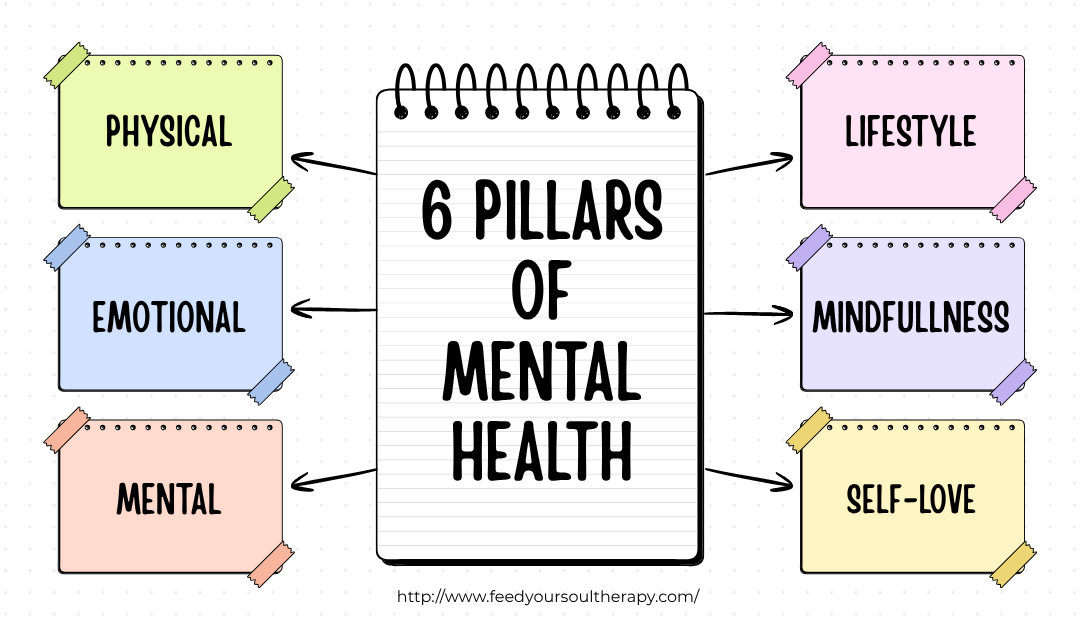
Mental health is multi-dimensional and that is why I talk about the 6 pillars of mental health. These 6 pillars are the foundation of the totality of who you are and how you can be mentally well.
The six pillars of mental health are:
- Physical Health
- Emotional Health
- Mental Wellness
- Lifestyle
- Mindfulness
- Self-Love
I find that many “Self-Health” gurus focus on one of the pillars, maybe two AND this is insufficient to create lasting change.
Together, these pillars create a holistic foundation for emotional resilience, stress management, and overall mental wellness.
The 6 Pillars of Mental Health
-
Physical Health
Your body and mind are not separate. We are learning more about the connection between how our body functions and how we are thinking and feeling.
When we look at physical health the attention often falls to weight. I have talked about weight issues and weight stigma often. Nutrition is one of the many aspects of physical health and there are quite a few other areas:
- Sleep
- Movement
- Nutrition
- Nervous system regulation
When we are “off” it tends to show up physically. Our nervous system regulation shows up in physical symptoms that can clue us onto a problem.
I like to ask myself the question, “What is your body trying to tell you right now?”
Tools that can increase your physical health.
It can be easiest to start with one small habit
-
- Hydration
- Walking
- Consistent sleep time
- Food that nourishes your body
-
Emotional Health
Let’s start with a key fact that feeling emotions is not the problem, avoiding them is. In my practice as a psychotherapist avoiding feelings is often the result of a year’s long pattern of disconnecting from our emotions.
It makes sense to disconnect from feelings that are upsetting, because you do not know what to do with them. I know that the more you avoid them, the more they show up at others times unannounced.
I think the starting point with all these pillars, especially, is to start being curious and recognize them. Emotional Awareness is the first step.
Suppressing emotions means we are out of touch with so many parts of ourselves: our emotions, our physical sensations and we can then be out of touch with the people around us.
This is a process that is gathered over time. I invite my clients to
- Sit with feelings
- Name their emotions
- Be curious about them
I like asking the questions:
- What emotion have you been avoiding lately?
- What emotion has been showing up often?
Tools can increase your Emotional Health.
- Name the feeling → locate it in the body → allow it.
- Naming the feeling can be simple if you use some basic terms:
- Happy
- Sad
- Scared
- Lonely
- Bored
- Angry
- After you name the feeling, locate it in your body. Where in your body are you feeling this? Some places I find my clients identify are:
- Anger is found in their tense neck
- Frustration is found in their tight shoulders
- Sadness is found in their tears
- Fear is found in their tight chest
- It can be scary to allow yourself to feel the feeling. When we sit with a feeling with some intention, it does slip away. The feeling will not be there forever.
- If emotional overwhelm feels difficult to manage, therapies such as Brainspotting can help address deeper patterns stored in the nervous system.
-
Mental Wellness (Thought Patterns)
Our thoughts can be indicative of a problem in our lives. Our thoughts can be overwhelming and intrusive in a way that can be quit negative.
Thoughts shape perception AND they’re not always truth.
I tell my clients that just because they think something does not make it true.
Thoughts are indications there is an inner critic that wants to bring us down.
Our thoughts can add information that we do not know to be true. It is like our thoughts can get 10 steps ahead of a situation AND make it worse.
There is also a tendency to put meaning to what others are saying/doing that is not based on the truth at that moment.
I like the THINK acronym
- T= Is it true.
- H= Is it helpful
- I= Is it inspiring
- N= Is it necessary?
- K= Is it kind.
You do not have to believe every thought that you have. I say you made the thought up and you can unmake it up. Meaning you can investigate the thought to see if it is true.
What are Mental Wellness Tools?
I find it is helpful slow down and questions what our mind is telling us is true.
- Recognize whether there is some agitation or dysregulation in your body.
- Take a deep breath.
- Ask yourself, What do I know to be true?
- Wait for the answer and keep breathing.
- If the thoughts are positive and helpful you are probably moving in the right direction.
Generally, we are responding from our inner critic. The voice in our head that tells us we are wrong or others are wrong.
It is the part of our head that also makes things up. We make up stories in our head that is not always based on reality.
-
Lifestyle
How you move through your daily life either supports or drains your mental health.
The Lifestyle Pillar for mental health is a significant one. Lifestyle is about your day-to-day life.
Think of the Lifestyle Pillar as:
- Work/School
- Family/Children
- Play
- Money
- Family of Origin
- Social Relationships
As you might be able to tell, the Lifestyle Pillar plays into all the other pillars. Emotions and thoughts affect how we live our lives on a day-to-day basis.
In recognition of the vastness of this pillar, lets look at how we can address what shows up in our relationships.
Boundaries play a huge role in how we address what goes on in our lives. Boundaries are ultimately how we can take care of ourselves AND not take care of ourselves.
- Can you embrace a work/life balance?
- Do you people please and let others take advantage of you?
- Do you say yes when you mean no?
- Do you take care of others at your own expense?
Increase your Lifestyle response
Tools that we want to embrace in our Lifestyle is ones that help us determine what is important to us.
-
- What aspect of your life causes you concern?
- Where in your life are you saying yes when you should say no?
- One boundary you can set this week?
-
Mindfulness
Mind/body/spirit awareness creates choice and opportunity.
Mindfulness is simply being present in yourself without judgment
There are so many misconceptions about Mindfulness. It is not about clearing your mind and taking away your thoughts or feelings.
Mindfulness is about getting quiet to hear, ultimately, that still small voice inside of you.
The benefits of mindfulness is that it interrupts going into autopilot with our thoughts, feelings and behaviors.
Mindfulness Tools
- Try breathing in for 6 second breath, hold for 6 seconds and then let the air out for 6 seconds. This can be the reset that you need when upset.
- Wash your hands with cool water and a lovely smelling soap!!! Extra points for putting on a lotion you love.
- Walk outside and feel your feet on the ground. This is a fantastic grounding exercise.
-
Self-Love
Your relationship with yourself (self-love) sets the tone for everything else.
We live in a society that is so critical and I find our thoughts can be equally critical.
Self-Love gives us an opportunity to calm down our mind, thoughts and behavior.
We need to reframe Self-Love:
- It is not a bubble bath.
- It is not a pedicure.
- It is the way you talk to treat ourself.
Many high-achieving women believe self-criticism keeps them motivated. They focus on telling themselves what they do wrong, which ends up feeling defeating.
Chronic self-judgment often increases anxiety, burnout, and feelings of inadequacy.
The inner critic can run wild AND the antidote is self-love.
There are many tools to increase Self-Love
-
- Would you talk to someone you love the way you talk to yourself?
- Practice replacing harsh self-talk with neutral/compassionate language
- Imagine talking to yourself as if you were a younger child. What would you say to them?
How the Pillars Work Together
These 6 pillars are interconnected, not separate silos. You need all of them in balance.
Poor sleep (physical) can lead to emotional reactivity, which can lead to negative thinking and ends in strained relationships.
You can’t fix everything at once, that is impossible!
Ready to strengthen your mental health?
The good news is you do not have to focus on all 6 pillars of mental health all at once!
Over time as you move through all the pillars, you will notice a subtle shift in your feelings about yourself and your life.
Let’s create some mental health habits. Here is your invitation to choose one pillar to focus on this week.
Physical Pillar
- Take a walk 1 time this week.
- Drink 8oz of water daily.
- Go to bed at a regular time.
Emotional Pillar
- Name an emotion as you feel it.
- Acknowledge your emotions.
- Write about an emotion in a journal.
Mental Pillar
- Notice your destructive thoughts.
- Be curious about the thought.
- Let the thought drift away from your mind (I like washing my hands to get me connected back with my body).
Lifestyle Pillar
- Say yes to something you really want to do.
- Say no to something you do not want to do.
- Plan an activity that is FUN.
Mindfulness Pillar
- Take a 6-second-deep breath, hold for 6 seconds and let it out for 6 seconds.
- Smell an essential oil. Put it on your wrist or on your neck.
- Wash your hands with a soap that you love.
Self-Love Pillar
- Chose a positive affirmation. “I am here” is a favorite of mine.
- Find beauty in your surroundings.
- Tell yourself, I Love You.
Now that you have identified which pillar to work on put your commitment to yourself in your calendar. Even better, include telling a trusted person about it to hold yourself accountable.
Engaging in practicing these pillars is an opportunity to focus on curiosity over judgment.
In the end, here is what you need to know
Increasing your mental health is ongoing and is not something you “arrive at.”
It takes courage to look at your inner world and make the changes you need for your future.
Start with small, consistent care creates meaningful change over time.
If you are suffering you do not need to go through it alone, consider mental health therapy and counseling.
Kim McLaughlin, LMFT, psychotherapist, speaker, author, and host of the Feed Your Soul with Kim podcast. Kim helps high-achieving women improve their mental health, overcome emotional eating and binge eating, reduce anxiety, and create more joy and fulfillment in their lives. She offers online therapy throughout California and in-person counseling in Roseville, CA.
Schedule a free 20-minute consultation here. https://kim-mclaughlin.clientsecure.me/
by KimMcLaughlin | Jun 17, 2026 | Podcast
Intuitive Eating is a concept written about by two Registered Dieticians: Evelyn Tribole, M.S., R.D. and Elyse Resch, M.S., R.D., F.A.D.A. They found there were people that they worked with who could not follow a “healthy” eating plan and they realized that there was something deeper at work.
There were principles that when followed there is a freedom with food and weight no diet could achieve. Their ground breaking book “Intuitive Eating: A Revolutionary Program That Works” outlines their discoveries. Their ideas have been talked about by others, but they are dieticians who discovered a new way of looking at binge eating.
As a therapist, I work with many people who are compulsive/binge eaters. I have found using Intuitive Eating gets to the basics of putting food in its place as nourishment and nurturing as separate from food.
In our therapy sessions my clients and I focus on how they eat and what is eating at them. In this way we can get to the heart of the matter with their binge eating.
Ultimately, letting go of the emotional component with food and utilizing specific techniques to break through this problem many of them have had for most of their lives.
Here are the 10 core concepts of Intuitive Eating:
- Reject the Diet Mentality
- Honor your Hunger
- Make Peace with Food
- Challenge the Food Police
- Feel Your Fullness
- Discover the Satisfaction Factor
- Cope with Emotions without using Food
- Respect your Body
- Exercise- Feel the Difference
- Honor Your Health- Gentle Nutrition
I think these principles of Intuitive Eating are really a key component in helping someone who is a binge eater reconnect with their body and eat in a healthier manner. This is a process that takes time and effort, but the dividends are long lasting. No one can tell you how to do it for you. Sometimes it is necessary to have a safe trusted guide who can help you look at your emotional blocks, the history you have with food, the shame about your weight and your body. If you are suffering from binge eating, take the chance and reach out for help to get on the road to eating the way you were meant to eat without the emotional baggage.
Kim McLaughlin, LMFT, psychotherapist, speaker, author, and host of the Feed Your Soul with Kim podcast. Kim helps high-achieving women improve their mental health, overcome emotional eating and binge eating, reduce anxiety, and create more joy and fulfillment in their lives. She offers online therapy throughout California and in-person counseling in Roseville, CA.
Schedule a free 20-minute consultation here. https://kim-mclaughlin.clientsecure.me/
by KimMcLaughlin | Nov 26, 2025 | Holidays, Intuitive Eating
Can You Really Be an Intuitive Eater at Thanksgiving?
Thanksgiving and intuitive eating might seem like an unlikely pair. Thanksgiving is known for overflowing plates, endless choices, and the cultural expectation to overeat. Intuitive eating, however, is about listening to your body, honoring hunger and fullness, and approaching food with peace (not pressure).
But here’s the truth:
You can be an intuitive eater at Thanksgiving.
I’ve practiced intuitive eating for years, and I’ve supported clients who successfully enjoy the holiday without guilt, restriction, or bingeing.
If I can do it, so can you.
Why This Season Feels So Hard: The Holiday Trifecta
I call the stretch from October 1 to December 31 the Holiday Trifecta. It’s three full months of parties, sweets, special foods, and pressure to “let loose” with eating, paired with an equally strong expectation to diet/lose weight come January.
This is the binge-restrict cycle, and it isn’t a personal failure. It is a version of our culture that shames you for eating. The holidays amplify this message.
Here’s what happens…
Dieting and restricting throughout the year often lead to overeating during special occasions (any holiday). When we limit foods, they become more tempting. When they eventually show up again—like holiday meals—we naturally want more. This is not a lack of willpower. It’s the predictable backlash of restriction.
Halloween, Thanksgiving and Christmas are one month after the other, which creates a lot of pressure around food. The pressure continues with social and familial expectations.
Intuitive eating offers a different path.
How to Be an Intuitive Eater at Thanksgiving
Here are the practices that support me (and my clients) in feeling grounded, peaceful, and connected at holiday meals:
1. Spend part of the day with movement that feels good
This year I am going to a morning yoga class. Other years, my family participated in a local turkey trot or taking a long walk. It isn’t about earning food or burning calories, it’s simply enjoyable activities. Movement can be part of your holiday if it feels nourishing, not punishing.
I enjoy taking a walk after the Thanksgiving meal. It is a great way to get out of the house and get centered.
2. Eat regular meals all day and don’t “save up” for the Thanksgiving meal
One of the biggest mistakes I see people do is not eat all day, so they can “earn” a big meal later. This can lead you to feeling overly hungry, which is a set up for overeating.
On Thanksgiving day, I eat breakfast and lunch just like any other day. When I arrive at the Thanksgiving table, I’m neither starving nor planning to tightly control myself. I choose foods I genuinely want, serve a portion that feels satisfying, and remind myself I can always go back for more.
And you know what?
After years of intuitive eating, I usually find that my first plate is enough.
3. Tune into Hunger and Fullness
Before eating, I check in with my body:
- Am I hungry and how hungry am I?
- What sounds satisfying?
- How will this food make me feel?
Pay attention to both hunger cues and satiety (fullness) cues. Stopping when I’m comfortably full—not stuffed, not deprived. Listening to my body is a skill, and Thanksgiving is a great time to practice.
I have learned that feeling stuffed afterwards is not an enjoyable physical feeling, so I do what I can to avoid it.
4. Care for your emotions
Food isn’t the only challenge at Thanksgiving. Emotions can run high: family dynamics, stress, overstimulation, or expectations can be overwhelming.
I always create a plan to address my emotions ahead of time. My plan often involves:
- Taking a short walk
- Switching conversations
- Taking a few deep breaths
- Stepping outside for quiet
- Finding someone supportive to chat with
Emotional care helps prevent turning to food as the only coping tool.
Think about what you may need emotionally this year and give yourself permission to honor those needs.
Holiday Foods Aren’t Special-Unless We Make Them Special
A big driver of holiday overeating is the belief that certain foods are only available once a year. Marketers fuel this idea with seasonal items (hello, Pumpkin Spice Latte) that create a sense of scarcity.
But here’s the truth:
Most Thanksgiving foods are available year-round.
We could make turkey or pies in March if we wanted. I used to think that mashed potatoes are only available during the holidays. We began to have the more often, because we like them.
When we allow ourselves year-round access to the foods we love, something powerful happens:
habituation.
When we are freely offered food anytime of the year, it is not this irresistible food anymore. We are then less likely to overeat it.
This is why intuitive eating works so well during the holidays, food is never forbidden, and you’re not entering the season from a place of deprivation.
Societal and Cultural Messages About Holiday Eating
These messages are everywhere at this time of year, and they keep us stuck in the binge/restrict cycle:
1. You must exercise to “earn” your meal.
How many times have you heard someone say, I’m going to the Turkey Trot this morning, so I can eat our Thanksgiving meal. This reinforces punishment-based movement and disconnects you from your body. A lot of people I work with do not exercise because it has been seen as punishment for eating.
2. Plan your plate by calories, points, or macros.
Diet culture tells us to pre-decide what we “should” eat. Intuitive eating allows you to choose what you want in the moment. I remember being on a diet where the instructor told us the week before to plan what we would eat on Thanksgiving. I found this was an impossible task. I now know that I go from an intuitive eating mindset and chose in the moment what will work for me.
Granted, there might be a certain style of eating that fuels your body better, do what fits you!
3. Restrict all week so you can indulge on Thanksgiving.
I used to hear this in from diet gurus who said we should eat less during the week so we can eat more at Thanksgiving. This is a setup for overeating, shame, guilt and binging. You deserve to have the right amount of food all week, regardless of what you eat at a holiday meal.
4. “Eat as much as you can—it’s the only time you get this food!”
Overeating is increased by the scarcity mindset. Truthfully, holiday foods are generally always available. In my area we can get foods at most times of the year OR we can freeze foods to eat later. Part of what makes holidays so special is the foods that taste so good and can remind us of our past.
5. Expect to feel physically sick afterward.
NO, it is not normal to expect to feel sick after you eat. I like to have what I want and tell myself; I can have more later. Planning to feel uncomfortable in your body (overfull) is not a loving way to treat yourself.
I encourage you to lean into honoring your bodies needs no matter what holiday it is.
6. Feel guilty because you ate too much.
Sometimes we eat too much for any number of reasons. This is the time to be kind to yourself and lean into more self-love. One of my core principles is to embrace more self-love.
7. Make low-fat or low-calorie versions of your favorite treat.
Ugh, on a holiday I do like the version that tastes the best- not the one that is the lowest calorie. We want to feel satisfied after the meal, which supports our body’s needs.
What If You Ate Intuitively All Year Long?
Eating on Thanksgiving is no different from eating later in the year. Intuitive eating can be the goal for each meal.
Your body doesn’t change its needs because it is a holiday.
Intuitive eating helps you approach every meal with the same mindset: centered, calm, and connected.
Here are some good Intuitive Eating questions to ask yourself…
- What would it feel like to eat intuitively 365 days a year?
- How can I drop the holiday panic and the January guilt?
- When do I trust my body to tell me what it needs?
If I can do this, you can do this. This is possible for you.
Consider what your next step could be?
Think about one way you could bring intuitive eating into your Thanksgiving this year.
It might be:
- Eating breakfast
- Serving yourself what you actually want
- Stopping when you’re satisfied
- Caring for your emotions
- Taking a calming breath before you plate your food
You don’t have to overhaul everything all at once; just small shifts create big peace.
I wish you a holiday filled with food freedom, emotional ease, and deep connection with your body.
You deserve all of this and MORE!!!
Kim McLaughlin, LMFT, psychotherapist, speaker, author, and host of the Feed Your Soul with Kim podcast. Kim helps high-achieving women improve their mental health, overcome emotional eating and binge eating, reduce anxiety, and create more joy and fulfillment in their lives. She offers online therapy throughout California and in-person counseling in Roseville, CA.
Schedule a free 20-minute consultation here. https://kim-mclaughlin.clientsecure.me/
by KimMcLaughlin | Jul 29, 2025 | Wellness
When people think of confidence, they often imagine someone walking into a room with charisma, standing tall, speaking clearly, and seemingly not caring what others think. Truth is, confidence is much deeper and more personal than outward appearances.
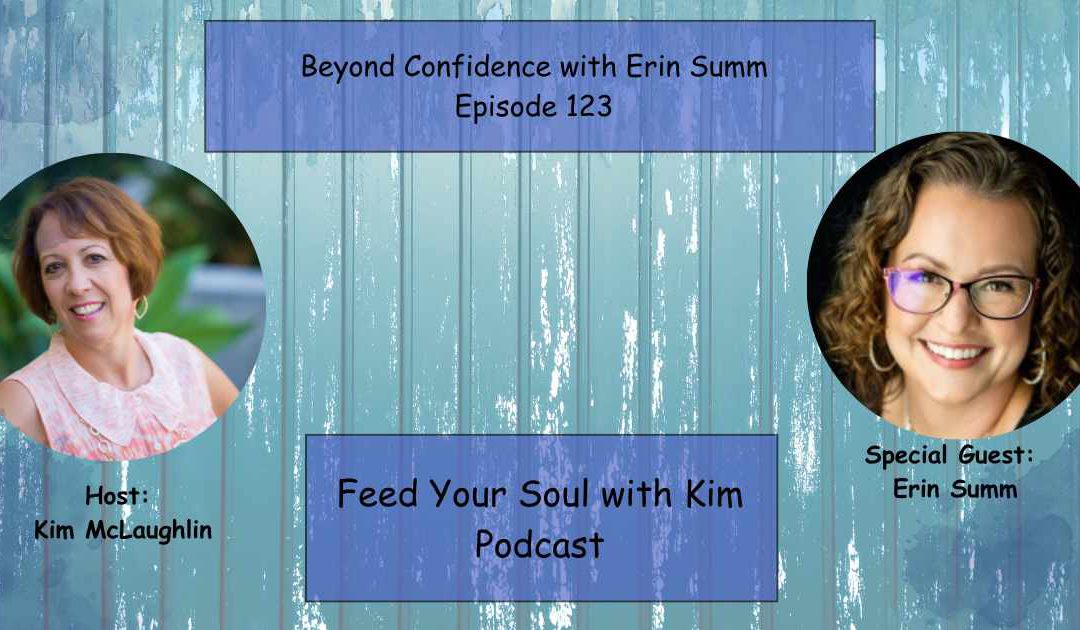
In a recent episode of the Feed Your Soul with Kim podcast, I sat down again with my longtime friend and confidence coach Erin Sum. Erin was my very first podcast guest back in 2019 (Episode 24), and we had a powerful conversation then about how to build confidence. This time, we went even deeper, because confidence isn’t a one-time achievement. It’s an evolving, ever-expanding journey.
If you’ve ever struggled with self-doubt, perfectionism, or that inner voice telling you “you’re not good enough,” we got you.
From Shy to Confident: Erin’s Story
Erin shared a vulnerable and inspiring story about how her confidence journey began. As someone who once identified as extremely shy, she never imagined she would one day speak on stages or coach others to embrace their power.
Her turning point??? She joined Passion Parties — an in-home party company selling relationship-enhancing products. Erin had to speak in front of groups, lead events, and sell products that made most people blush. It was uncomfortable, bold, and totally transformative.
“That was a massive leap outside my comfort zone,” she said. “But I knew I was here to make a difference. I just didn’t know how to do it until I took that step.”
This leap set off a chain reaction that led her to discover life coaching, eventually becoming a full-time confidence transformation coach.
Isn’t Shyness and Confidence the Same Thing?
One of the most fascinating parts of our discussion was around the connection between shyness and confidence. Are they always linked?
Erin believes that, in many cases, they are linked.
“Shyness often means we’re shrinking ourselves, holding back from being who we really are,” she explained. “It’s not just about being quiet — it’s about hiding your light.”
That doesn’t mean every quiet person lacks confidence. But when shyness is rooted in fear of being seen or judged, it can be a signal to look inward and ask:
- What am I holding back?
- Why am I afraid to be fully seen?
- What is the worst that could happen if I am seen?
5 Hidden Signs You Might Be Lacking Confidence
Low self-confidence can show up in sneaky ways. Erin and I discussed several phrases and habits that people don’t always associate with confidence, but which are clear signals:
- “I don’t deserve that.”
Whether it’s a compliment, a raise, or a relationship, feeling unworthy is a hallmark of low confidence.
- Second-guessing yourself constantly.
If you can’t decide without spinning your wheels, it’s often rooted in self-doubt.
- Putting things off because you fear failure or judgment? That’s confidence hiding in the shadows.
- The need to “get it right” before acting can paralyze you — more on that later.
- Not taking action.
Inaction isn’t laziness! It’s often fear disguised as hesitation.
Confidence is a Practice, Not a Destination
One of the most empowering ideas Erin shared was this:
“The more confident you become, the more those limiting beliefs fade away. But they come back- just at a different level.”
There’s a saying: “New level, new devil.” Erin offered a twist: “New level, old devil,” because often, the same fears resurface, just in new disguises.
Maybe you’ve conquered public speaking in small groups, but now you’re afraid to speak at a conference. Or you’ve built a business, but now you’re scared to raise your rates.
That’s not failure. That’s growth.
Really, confidence work is never really “done.” It evolves with you.
Let’s Talk About Perfectionism
Oh, perfectionism: the enemy of creativity, progress, and peace of mind.
Both Erin and I admitted that we’ve fallen into the perfectionism trap. As a Virgo and an only child, Erin joked she was “triple-whammied” with the perfectionism gene.
“I used to spend so much time perfecting a web page or writing,” she said. “Eventually, I had to accept it was never going to be perfect.”
Her favorite mantra (which I now use regularly) is from our mutual mentor, Caterina Rando:
“Done is better than perfect.”
It sounds simple, but it’s a game-changer. Every time I remind myself of this, I can move forward even when things feel messy.
If you’ve ever held back because you couldn’t get something just right, you’re not alone and that’s perfectionism at work.
Haters are Helpful!!!
This might surprise you: one of the biggest confidence boosts Erin ever experienced came from getting her first “hater.”
Yep, someone in her community tore her down publicly. Instead of shrinking, Erin celebrated. She even made a video that night (in her hoodie, no makeup, 9 p.m.) and said:
“Getting a hater means I’ve made it. It means I’m standing for something.”
That video became her most-watched video ever.
Here’s why this matters: If you put yourself out there, people will criticize. Some might even try to tear you down. That’s not a sign to stop — it’s a sign that you’re being bold.
Truth bomb: The people who truly care about you don’t need you to be perfect. And the people who demand perfection? They’re not your people.
Small but Powerful Ways to Build Confidence
So how do we build confidence? Especially if we feel stuck, scared, or deeply self-critical?
Erin offered four simple but powerful steps:
- Ask yourself: What am I afraid of?
Often, naming the fear is enough to take away its power. We tend to exaggerate what might go wrong.
- What’s the worst-case scenario?
Be honest. If you speak up in a meeting, what’s the actual worst that could happen? Usually, it’s not nearly as bad as your brain makes it out to be.
- How would I act if I felt confident and bold?
Imagine your future self, the one who’s already living confidently. What would they do right now?
- Take one small step.
Not a leap. Just a step.
- Send that email.
- Make that call.
- Speak one sentence
Confidence grows with action, not waiting.
Confidence in Real Life: What It Looks Like
Let me share a personal story: I recently had to attend a networking event. As someone who often helps others navigate fear and discomfort, people assume it’s easy for me. It’s not. I had to sit myself down and say:
“Kim, just go. Show up as you are. You’ll find your people there.”
I did and I had conversations that mattered.
The fear beforehand was real.
Leaning on my confidence tools helped just like they will for you.
Confidence doesn’t mean fear is gone. It means you show up anyway.
The Power of Community
One of the most underestimated parts of building confidence is community.
Erin and I both emphasized how important it is to surround yourself with people who:
- Celebrate your growth
- Encourage your bold steps
- Support you when fear shows up
If you don’t have those people in your life yet, seek them out. Join a group. Hire a coach. Talk to a therapist. We are not meant to do this alone.
Self-Reflection: Confidence Check-In
Here are a few journal prompts to help you integrate what you’ve read:
- Where in your life are you currently holding back?
- What fear is underneath that hesitation?
- How would you act if you believed in yourself just 10% more?
- Who in your life encourages your confidence — and who drains it?
- What’s one bold (but manageable) action you can take this week?
Finally, You Deserve to Shine
Confidence isn’t about being loud, being “perfect,” or having it all figured out.
- Trust yourself, even when you’re unsure.
- Show up, even when you’re scared.
- Act, even when you’re doubting.
- Believe, even when you feel shaky.
If you’re struggling with low confidence right now, take a breath. You’re not alone, and you’re not broken. Confidence isn’t something you either have or don’t — it’s something you build. One small, brave action at a time.
Erin and I are living proof of that.
So today, ask yourself:
✨ What would I do if I trusted myself just a little more?
Now go do that.
Want more?
🎧 Listen to the full Feed Your Soul with Kim podcast episode #123 “Beyond Confidence” with Erin Sum. https://podcasts.apple.com/us/podcast/123-beyond-confidence/id1473042304?i=1000717437412
🌀 Subscribe to hear more stories, insights, and practical tools for emotional well-being, confidence, and empowerment. https://podcasts.apple.com/us/podcast/feed-your-soul-with-kim/id1473042304
You’ve got this — and we’ve got you.
Disclaimer: This blog is not a replacement for mental health counseling. If you are suffering, seek out a qualified mental health provider. You are worth it!!!
Kim McLaughlin, MA is a Psychotherapist, Speaker, Author, and Coach who helps people literally feel better in their lives.
She specializes in providing therapy for people who suffer from binge eating and emotional eating. She is a Certified Intuitive Eating Counselor. She is the author of the best-selling book Feed Your Soul Nourish Your Life! A Six Step System to Peace with Food and the Amazon #1 Best Selling book Discovery Your Inspiration.
You can find Kim on her podcast Feed Your Soul with Kim and you can find it on all podcast platforms.
Wondering if you are an emotional eater? Sign up for the free Am I an Emotional Eater Quiz.
Erin Summ is a Confidence Coach. You can find out more about her on her website- https://erinsumm.com/
Check out her Bold Confident Speaker Series: https://erinsumm.com/empoweredwoman-speakerseries/







 Kim McLaughlin, LMFT, psychotherapist, speaker, author, and host of the