The Self-Love Blueprint

The Self-Love Blueprint

Facebooktwitterpinterestlinkedinmail

As a psychotherapist, I listen to people talk daily about how much they dislike or even hate themselves. I am not surprised by the comments and through the therapeutic process we ultimately focus on how to create more self-love.

When we discuss love, it starts out with the love of others: spouse, partner, family, and children.

I say love starts with yourself and I know this goes against what we have been taught.Increase your self love by increasing your mental health. Therapy in california can help increase self love

We are taught to be loving to others and to put them first.

As they say when you ride an airplane the oxygen mask needs to go on YOURSELF first.

You can see there are mixed messages about love and why there is a requirement for self-love.

There is a blueprint to self-love that you might not know.

Let’s start with the definition of a blueprint: “a guide for making something — it’s a design or pattern that can be followed.”

Since we have generally not been taught about self-love, I want to go over the blueprints.

Yes, there is a guide for enabling self-love.

First, what is self-love?

I wrote a whole chapter about Self-Love in my book: Feed Your Soul; Nourish Your Body! A Six Step System to Peace with Food.

Self-Love is one important component in making peace with food. When you have food issues, we begin to think so negatively about ourselves. Focusing time and effort on self-love helps with food issues AND it helps with a lot of other issues you might have.

In my book I wrote a whole chapter about self-love. The book focuses on making peace with food, so you might think this topic does not apply to you (you might not have an issue with food).

Women especially are taught to not pay attention to their own needs.

Being loving is not always present in our society today. There is a lot of negativity all around. I noticed so much more negativity with the rise of the internet and the rise of unfiltered comments.

Isn’t self-love selfish?

We are primed to not value being loving to ourselves, and it can be considered selfish. We often tend to overlook self-love for fear of being selfish. As I stated above, self-love is the most important kind of love.

I see a common misconception is that self-love means you are selfish and self-centered. When you look at it that was you are missing the need for each of us to focus on our own needs and once we can take care of our own needs (hence the mask on the plane) then we can look to help with others needs.

Why is self-love so important?

There are different aspects to consider at when we look at Self-Love:

  • Self-Esteem- which is how you feel about yourself. Your sense of value and good feelings about yourself.
  • Self-Worth- which is how you see your value in the world. Do you think you have the right to exist? This is such a difficult concept, especially when we have food and weight issues.
  • Self-Expression- how do you go about with how you individually express who you are verbally, what you wear, what you do, etc.

When we are in alignment with our self-esteem, self-worth, and self-expression- it is easier to love ourselves.

Many of us tend to feel stuck in the negativity. Without self-love there is not a way out of this spiral downward.

If you can do one thing for yourself to help your emotional and mental wellness, increase your self-love.

There is a blueprint to engage in self-love.

Here are some practical ways to increase self-love

1) Start and end the day by saying something positive to yourself.

This sets up your mind and spirit for the positive. You can do it more often during the day for a greater benefit. I love books by Louise Hay who has a mirror method where she would look at herself in the mirror and repeat positive affirmations. It is a powerful method.

Here are some positive statements to tell yourself:

  • I love you.
  • I appreciate you.
  • I care for you.
  • You are valuable.

It is very powerful to repeat those affirmations in front of the mirror while you look at yourself.

In one of my yoga classes my yoga instructor has us tell ourselves. “I love you” at the end of the class.

Telling yourself, I Love You, out loud is a powerful way to reinforce that self-love.

2) Stop judgment of yourself and others.

This can be easier said than done. I find the starting point is to notice the judgment and name it. Call it judgment. This can help you notice it when it is happening. It is not a time to get angry or frustrated with yourself, it is a time to recognize it AND wonder what it means to you.

  1. Why am I judging?self-care is not selfish, therapy, therapy california, therapy for high achieving women
  2. What does the judgment mean?
  3. How can I release this judgment?

There is a lot of danger in comparing ourselves to others. If it is not uplifting and it brings you down. It does not matter what anyone else does if it is uplifting to you.

3) Be at peace in your mind.

How do you think about yourself? How much to you ruminate on what is going wrong and what is bad? Critical thoughts of yourself and others.

Peace can come in so many ways- I like to journal those thoughts; I like conscious journaling (morning pages) which frees my mind daily from all the chaos.

4) Say no to people, places, and things you need to say no to.

Is there chaos around you? People who are not kind to you? Self-love means I invite people to be with me that are kind and loving to me.

I can be more loving to myself when I surround myself with loving people. Remember before when we talked about the negativity on the internet and especially social media. Consider saying no to negative people who fill your feed with toxic statements. I have let go of many people on social media who just talk cruelly about others. I think it is ok to hear other opinions on social media, but not toxic statements.

5) Notice the negative statements you make about yourself.

Consider how you would talk to your child, niece, or nephew- a cherished child. Think of yourself as that cherished child. Tell that child side of yourself how great they are.

This blueprint is not an exhaustive list, and I invite you to add to the list.

Finding what works for you one day does not always work for another day.

Lastly, if these suggestions feel too difficult it might be time to seek out a licensed mental health counselor. A counselor can help you to look at yourself differently and then you will feel different about yourself.

Kim McLaughlin licensed psychotherapist working with high achieving women in CaliforniaKim McLaughlin, MA is a Counselor, Speaker, Podcaster, and Inspirational Coach who specializes in working with people who suffer from binge eating and emotional eating. She is a Certified Intuitive Eating Counselor. She is the author of the book Feed Your Soul Nourish Your Life! A Six Step System to Peace with Food and the Amazon #1 Best Selling book Discovery Your Inspiration.

You can hear Kim talk more on this topic on her podcast Feed Your Soul with Kim and you can find it on all podcast platforms.

Wondering if you are an emotional eater? Sign up for the free Am I an Emotional Eater Quiz.

Overcoming Candy Cravings: Find Food Freedom This Halloween with Intuitive Eating

Overcoming Candy Cravings: Find Food Freedom This Halloween with Intuitive Eating

Facebooktwitterpinterestlinkedinmail

Halloween used to be a tricky time for me, because of all the candy. I was always afraid I would overeat, gain weight and hate myself for it.

The aisles of colorful candy were hard for me to ignore, and my strategies for “managing” my candy intake became more elaborate each year.

If you’ve ever struggled with balancing holiday treats and Halloween candy, my story might sound familiar.

I transformed my mindset around candy—and you can too.

For years, I cycled through various strategies to avoid Halloween candy temptations:

  • I bought candy and tried not to eat it!!!

The tactic of not buying candy never worked as planned! I’d buy a stash and vow to leave it alone until Halloween. Inevitably, I’d sneak a piece here and there until I had to replenish it. I would constantly think about the candy and feel compelled to eat it.

  • I tried not buying candy at all.

My next strategy was to avoid buying it altogether. This strategy worked, because it was not in my house. I felt uncomfortable because I was avoiding dealing with candy. I wanted to feel comfortable with candy around AND not eat it all.

  • Avoiding Trick-or-Treaters was one of my interesting plans.

For years I would go to the gym on Halloween night to avoid being home when trick-or-treaters came by. If I got home while they were still out, I would hide in my bedroom and keep all the lights off. I feared Halloween for all of the wrong reasons.

  • Escaping to a Friend’s House

Some years. I would go to my friend’s house for the night to skip the candy stress. I thought if I just avoided the candy, I would be ok.

My husband LOVES to give out Halloween Candy.

I realized while I was dating my husband that he loves giving out Halloween candy to neighborhood kids.

Since he gave out candy and it was in the house, I realized I needed to come up with a different plan.

Next, when my daughter arrived, I knew it was time for a real change.

I found Intuitive Eating is the key component to heal my relationship with Halloween Candy.

Intuitive Eating showed me that food doesn’t have to be the enemy. I didn’t have to “manage” or “control” candy or any other foods. This idea was incredibly freeing, though it took some time to fully embrace.

Key Lessons in My Food Freedom Journey

There some components to help you understand how to use Intuitive Eating.

First, candy isn’t the enemy.

Realizing that there are no “bad” foods—even candy—was huge for me. Halloween candy wasn’t going to harm me, and I didn’t need to label it as something forbidden. When I take candy off of the “bad” list, it does not have power over me.

Second, fear and candy don’t have to go together.

Candy used to scare me because I feared losing control, gaining weight, or somehow “failing” my health goals. By letting go of these fears, I allowed myself to see candy as just candy. If I feel the fear, I focus on dealing with the fear NOT the candy.

Third, allowing myself to enjoy Halloween Candy.

Since I give myself permission to eat candy whenever I felt like it, removed its power over me. It was no longer a “special” or “forbidden” treat. It was just a choice, like any other. I have allowed myself to have candy throughout the year and it is not something special to be binged on at Halloween.

How you can begin your Own Journey Toward Candy Freedom???

If you’re working to make peace with candy (or any food), try these steps:Holiday candy, emotional overeating, therapy, therapy in california, Therapy for high achieving women

1. Challenge your thoughts about Halloween candy.

You can reflect on why candy feels scary.

  • Are you worried about weight gain?
  • Concerned about feeling out of control?
  • Do you fear “unhealthy” eating?

I like to notice the emotions and thoughts that come up and journal about them. Through the journalling process, I can determine what the feels really mean to me. Once I can see/feel the feelings and determine what I need, then candy is not all powerful.

2. Explore your beliefs around candy

  • What messages have you received about candy?
  • Do you associate it with guilt?
  • Question where these ideas came from and whether they still serve you.

As you explore your beliefs about candy you can see if they are true or not.

3. Bring in Self-Compassion

If you were approaching candy with kindness rather than fear, what would that look like? Remember, self-restriction doesn’t work in the long term. True balance means allowing yourself to have candy without guilt.

4. Practice Mindfulness to be present with the candy.

When you choose to eat candy, do it mindfully.

  • Savor the taste of the candy.
  • Enjoy the experience of the Halloween candy.
  • Do you like the taste?
  • Is there a point where it does not taste good anymore?

You might find that, over time, candy becomes far less of a big deal.

Now, I happily give out candy to our neighborhood kids. When my daughter returns with her Halloween haul, I can share a piece without the slightest worry.

Candy is just another food, and Halloween is just one day.

If you’re tired of feeling out of control around candy, know that there’s hope. You, too, can find food freedom. By rethinking your relationship with candy, you can make Halloween (and every day) a little sweeter. 🎃🍬


Kim McLaughlin, MA is a Psychotherapist, Speaker, Author, and Coach who specializes in working with people who suffer from binge eating and emotional eating. She is a Certified Intuitive Eating Counselor. She is the author of the best-selling book Feed Your Soul Nourish Your Life! A Six Step System to Peace with Food and the Amazon #1 Best Selling book Discovery Your Inspiration.

You can find Kim on her podcast Feed Your Soul with Kim and you can find it on all podcast platforms.

Wondering if you are an emotional eater? Sign up for the free Am I an Emotional Eater Quiz.

Increase your confidence: an interview with Ebony Moore, Confidence Coach


Increase your confidence: an interview with Ebony Moore, Confidence Coach

Facebooktwitterpinterestlinkedinmail

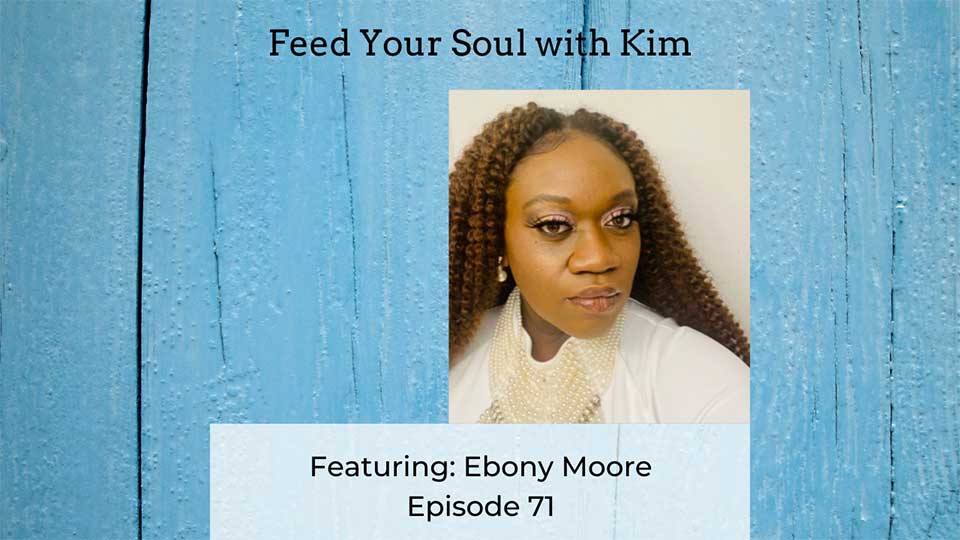
I had the opportunity to have a conversation with Ebony Moore for the Feed Your Soul with Kim Podcast about confidence. We had met earlier when I was a guest on her podcast BossWife.live.

Ebony talks about confidence through the lens of modeling. She started modeling when she was 12 and now owns a modeling studio.

She talks about starting at Barbizon one of the big top modeling studios. They liked her and wanted to work with her, but they had two options for her: 

  1. She could shave all her my hair off (she was a teen!). Because she always wears her hair towards her face, and she was told it makes her nose look bigger. 
  2. She could get a nose job (she was a teen!). 

Can you image being a teen and told you either needed to shave your hair or get a nose job? She chose neither and started modeling locally. As she started to model locally opportunities began to open in New York, Chicago, and Atlanta. This led to greater self-esteem. 

After getting married at 18 years old she started to have kids and her confidence “took this huge blow, because she had gained weight.” She says she felt like she was “nothing” and her whole identity was wrapped up in her size. 

Ebony acknowledges, “I definitely misplaced my identity, I didn’t lose it, I just misplaced it.” She gave up hope. 

“I felt like my body was just unacceptable, because when you’re not supposed to be overweight.”  Ebony Moore

She started to focus on getting up and getting herself ready and going out. Not staying isolated. Getting up and out helped move her into more confidence. But the change came when she changed her thoughts about herself. 

“It was definitely all mental.” Ebony Moore

Ebony saw how focused we can be on how our bodies look and we lose track of who we really are. We can tend to think who we are is the size and perception of our body.  

How do you move into feeling more confident? 

Start noticing others (ebony noticed it in her kids) experiencing joy in their bodies. 

“I wanted them to know, regardless of who you are, what you like, what your nose looks like, what your hair looks like, you are freaking amazing. Like nobody else in this world looks like you. Watching my children helped me to rebuild my confidence.”

Ebony Moore

Kids can have natural confidence that adults have lost. Ebony talks about noticing the confidence in her kids and the kids in her modeling studio. She saw that she had to give that confidence to herself and then to others. 

Mirror work as a method of confidence building.

In confidence building using the concept of reflecting can be powerful. Ebony does what she calls “mirror sessions” where it’s just you in the mirror. It’s just you, looking back at you. You kind of talk to that person who you used to be.  

Using the mirror to really look at yourself and be ok with yourself. 

Here is her method: 

  • First, get in front of the mirror.
  • Second, look at yourself without make up.
  • Third, look at every mole, every hair that’s out of place, every hair on your chin. What do you like about your ear lobes? Look at your skin, notice the color. 
  • Fourth, take a deep breath and appreciate the beauty of you.  

Love yourself the way you are because that’s who that’s what people are attracted to. People are attracted to you. 

Use mirror work to increase confidence? 

  • First, remind yourself of who you used to be. 
  • Second, imagine going back to being a child. Remember that child-like love for yourself? 
  • Third, what was it about yourself that you loved the most, whether it was your eyes, whether it was your hair, your nose, your lips, whatever your skin color, the shape of your face, that’s the person you need to remember. 
  • Lastly, fast forward to now, what has changed? Recognize that you are the same person. Reconnect with that love for yourself. 

Now that you have reconnected with your true self, ask yourself, “How do I need to be there for me today?” We know you will be there for everybody else. How you need me to be there for you?

We put out the caring for others, but how are you showing up for yourself? 

When we start looking at ourselves in this way we are moving beyond confidence into “Who am I?” This way of looking at ourselves becomes spiritual, and, and mindful. 

How do you increase confidence daily?

Ebony recommends you send yourself an automatic text message daily to encourage yourself. 

Some of her confidence texts are: 

  1. Ebony, how can I be here for you today? 
  2.  Ebony, I need you to be strong for me today. 
  3. Ebony. I need for you to go the extra mile for me today.

Ebony recommends you can open the text at various times of the day to bring yourself back into that place of confidence. 

Increased confidence is a game changer in life. Try some of her tips and let us know how it works in the comments below. 

Check out my recent podcast with Ebony Moore and learn more about her confidence coaching and modeling studio at: 

www.Bosswife.live

www.purposefulthinking360.com

www.enchantedreflectionsstudio.com

https://spreaker.page.link/pW9szrANrXs3Yc2E8

https://www.linkedin.com/in/ebony-moore-1ba58984/


Kim McLaughlin, MA is a Counselor, Speaker, Podcaster, and Inspirational Coach who specializes in working with people who suffer from binge eating and emotional eating. She is a Certified Intuitive Eating Counselor. She is the author of the book Feed Your Soul Nourish Your Life! A Six Step System to Peace with Food and the Amazon #1 Best Selling book Discovery Your Inspiration

You can find Kim on her podcast Feed Your Soul with Kim and you can find it on all podcast platforms. 

Wondering if you are an emotional eater? Sign up for the free Am I an Emotional Eater Quiz. 
Food Freedom: Mindfulness

Food Freedom: Mindfulness

Facebooktwitterpinterestlinkedinmail

Today, I want to really focus more in on what it means in our body and in our mind to be mindful what that would look like. 

Why would we want to be mindful? 

Being mindful/mindfulness is one of the best ways to reduce stress. 

The other thing that mindfulness does is it increases our ability to be an intuitive eater. Intuitive eating allows us to move off the diet and into being present in our bodies: to eat from that inner knowing. 

Mindfulness increases intuitive eating. 

It is critical that we are more mindful so we can increase intuitive eating. We are then in our body when I when we eat, we’re more in our body to notice if we’re hungry to notice if we’re full to notice if we’re distracted to notice it for uncomfortable. 

Mindless eating takes us out of our bodies. 

I have learned from countless clients and my own personal experience is when we are mindlessly eating, it is being like outside of our body. We are not fully present in our bodies, we’re not fully embodied, and we’re outside of our body. 

When we’re outside of our body mindlessly eating, that is when we’re not paying attention to:

  1. Whether we’re hungry.
  2. Whether we’re full. 
  3. Whether we need to stop.
  4. We eat fast. 
  5. We don’t taste our food.  

Since we’re focused outside of our body, mindlessly eating, we’re not focused on those internal cues that tell us it’s time to stop. We want to eat intuitively. Remember, children know how to eat intuitively. Children know when they’re hungry. Children know when they’re full. Small children will close their mouths when they are physically full. They will not eat more than what their body needs. 

When my daughter was younger when she was full, she would say my tummy says no more. She just knew her physical signals. 

Mindfulness is one of the best ways to get us back in touch with our body, so we can intuitively eat. It creates a sense of peace in our bodies. Mindfulness helps us beyond intuitive eating. 

I started at the first of January doing a mindfulness practice every day. It’s a short like practice that I do every day. My ability to manage my life, my ability to manage stress, my ability to just know what to do has been increased exponentially. My big why of why I am mindful is to have peace in my body, and peace in my life, peace in how I react to everybody. 

How do you become more mindful? 

You might not want to do a daily mindful practice, like I’ve been doing. But you need to start somewhere. 

First, you can be more mindful during your meals. 

  1. Sit at the table. 
  2. Don’t eat while you are driving. 
  3. Don’t eat while you are distracted. 
  4. Sitting down while you eat. 
  5. Eat at the table. To me it just reminds me that I am here to feed my body.

Second, you can have a more mindful connection to your food. I like to remember that I am here to fuel my body. Chew your food well. Taste it, savor it. 

Third, feel in touch with your body as you eat. Take time to notice if you are satisfied with the food. Are you still hungry? It’s a radical concept to be in touch with your body while you’re eating while you’re eating. 

I encourage you to practice these mindful techniques. 

Because if you’re like me, I come to the table about three times a day, I come to the table and sit and eat like literally and figuratively. So, you have three times a day (at least) to practicing mindfulness. Literally just get a plate of food, sit at the table, notice yourself seated, take a deep breath, and take a bite of food, put your fork down after each bite.  

Mindfulness is about being in touch with your body. 

Another mindfulness tool that I love that we don’t talk about much when we talk about much is movement. I find that some of my most mindful times are when I am in some kind of movement. Mindful movement can get in you in touch with your body in a way other actions cannot. 

I like to call it mindful movement. I resist using the term exercise, since for me and my clients that goes along with dieting. Exercise is for losing weight. Movement is for being in touch with my body and connected to my body.  

Mindful eating and mindful movement are ways to increase overall mindfulness. 

Lastly, there is something you can start right now. 

Focus on your breath 

When you focus on the breath, you’re being mindful, there’s no other way around it. When you focus on breathing in and breathing out. You’re, you’re in your body. Mindfulness is about being fully present. Where you what did we say earlier, it’s the ability to be fully present, and aware of where we are. And what we’re doing, being in the breath, is the best way to be fully present. So that just means breathing in and breathing out. There are a lot you can look up on YouTube, Google different ways to be in the breath. There are so many techniques that I don’t I can’t begin to go through all of them. What I noticed is when I am in the breath, why? How is it mindful for me?

Try it right now, breath in and breath out. What do you feel? Being in the breath is one of the best mindful tools to be fully present in your body. And that’s literally what we’re looking at with mindfulness. 

There’s no prescription about how you reach mindfulness, right? What we’re looking at is being in touch with our body, and in touch with what’s going on mindfulness, right. And when we’re more mindful, we’re going to be mindfully eating, and intuitively eating, which is exactly what you want. 

I encourage you to think of one way you can be mindful today: 

  1. A meal 
  2. A breath
  3. Mindful movement 

Put one of these techniques to the test to increase your mindfulness. Notice how it can help your eating and create more peace in your life.  


Kim McLaughlin is a psychotherapist, coach, podcaster, and author. She helps people who are struggling with overeating and emotional eating. You can find out more at www.FeedYourSoulUnlimited.com

This blog is based on a Food Freedom Facebook Live where we went into depth about emotional eating. You can access the video here.

Food Freedom: Emotional Eating

Food Freedom: Emotional Eating

Facebooktwitterpinterestlinkedinmail

This is the second blog in a series focused on Food Freedom. The first in our series looked at the Diet Mindset and how it sets you up for failure. 

In talking about Emotional Eating, it is helpful to determine if you are one. Right? 

Here are some definitions to help you determine is you are an emotional eater:

  1. Do you eat when you are not hungry?
  2. Are you using food to make you feel good?
  3. Do you use food in situations where you feel uncomfortable?
  4. Are you eating too overfull?
  5. Do you feel ashamed when you overeat? 
  6. Do you feel bad about your body?

Each of these by themselves occasionally, is probably not something to be too concerned about. But really reflect on whether these questions fit for you AND how often AND do you feel upset with your eating habits.

Yes, sometimes we all overeat, and we eat for emotional reasons. Food tastes good and it is a primary need. If the way you eat causes you a problem, then it probably is a problem.

Eating should make you feel good, not bad.

Emotional eating means you are not dealing with emotions in a way that will fix the problem. The food can help emotions temporarily, but it is not the fix. Emotions need to be dealt with so there is a resolution. When food is used as the resolutions for emotions, the emotions aren’t settled: truthfully it will exacerbate the emotions. 

Identifying the problem can lead you to ask the question what should I do? 

First, you must notice you are eating for emotional reasons. Start to pay attention to your eating and if you are meeting the above criteria, begin to look deeper at what is going on. 

Second, acknowledge that you have a problem with emotional eating. There is a lot of healing that can come from the acknowledgment, because THEN you can do something about it (besides the continual diet). 

Third, start to identify your feelings. Some easy labels for feelings are sad, mad, happy, anxious, bored, lonely, and tired. Giving them a name helps you to move forward. 

Fourth, ask what those emotions are trying to tell you. I know that can sound odd, but there is a voice to our feelings, and they are there to give us information about what is going on inside of us. Give a try and ask you feelings to tell you what you need to know. 

Fifth, follow the advice of the feelings. Generally, the feelings tell me when I am out of balance and depending on the feeling, I can be steered to what I need to do to take care of the emotion. I like the concept of the Wellness Toolbox where I have a variety of ways to take care of feelings like journaling, walking, talking to a supportive person or meditation. 

You are getting a start at determining how emotional eating affects you. GOOD JOB. Next is to keep the movement going. Dealing with your emotions is one way to get food freedom. If you want more help, I suggest you join my Emotional Eating Solutions 8-week self-study. In this course you will learn about the 6 components we need to look at to address your emotional eating:

  1. Physical 
  2. Emotional 
  3. Mental
  4. Lifestyle
  5. Mindfulness 
  6. Self-Love

All these components need to be addressed to finally have freedom with food. Remember the problem with food has been there for a long time (often since childhood) will not just go away AND diets make it worse. You need to have a plan to address all 6 components AND how they interact with each other.

Kim McLaughlin is a psychotherapist, coach, podcaster, and author. She helps people who are struggling with overeating and emotional eating. You can find out more at www.FeedYourSoulUnlimited.com

This blog is based on a Food Freedom Facebook Live where we went into depth about emotional eating. You can access the video here.