The Self-Love Blueprint

The Self-Love Blueprint

Facebooktwitterpinterestlinkedinmail

As a psychotherapist, I listen to people talk daily about how much they dislike or even hate themselves. I am not surprised by the comments and through the therapeutic process we ultimately focus on how to create more self-love.

When we discuss love, it starts out with the love of others: spouse, partner, family, and children.

I say love starts with yourself and I know this goes against what we have been taught.Increase your self love by increasing your mental health. Therapy in california can help increase self love

We are taught to be loving to others and to put them first.

As they say when you ride an airplane the oxygen mask needs to go on YOURSELF first.

You can see there are mixed messages about love and why there is a requirement for self-love.

There is a blueprint to self-love that you might not know.

Let’s start with the definition of a blueprint: “a guide for making something — it’s a design or pattern that can be followed.”

Since we have generally not been taught about self-love, I want to go over the blueprints.

Yes, there is a guide for enabling self-love.

First, what is self-love?

I wrote a whole chapter about Self-Love in my book: Feed Your Soul; Nourish Your Body! A Six Step System to Peace with Food.

Self-Love is one important component in making peace with food. When you have food issues, we begin to think so negatively about ourselves. Focusing time and effort on self-love helps with food issues AND it helps with a lot of other issues you might have.

In my book I wrote a whole chapter about self-love. The book focuses on making peace with food, so you might think this topic does not apply to you (you might not have an issue with food).

Women especially are taught to not pay attention to their own needs.

Being loving is not always present in our society today. There is a lot of negativity all around. I noticed so much more negativity with the rise of the internet and the rise of unfiltered comments.

Isn’t self-love selfish?

We are primed to not value being loving to ourselves, and it can be considered selfish. We often tend to overlook self-love for fear of being selfish. As I stated above, self-love is the most important kind of love.

I see a common misconception is that self-love means you are selfish and self-centered. When you look at it that was you are missing the need for each of us to focus on our own needs and once we can take care of our own needs (hence the mask on the plane) then we can look to help with others needs.

Why is self-love so important?

There are different aspects to consider at when we look at Self-Love:

  • Self-Esteem- which is how you feel about yourself. Your sense of value and good feelings about yourself.
  • Self-Worth- which is how you see your value in the world. Do you think you have the right to exist? This is such a difficult concept, especially when we have food and weight issues.
  • Self-Expression- how do you go about with how you individually express who you are verbally, what you wear, what you do, etc.

When we are in alignment with our self-esteem, self-worth, and self-expression- it is easier to love ourselves.

Many of us tend to feel stuck in the negativity. Without self-love there is not a way out of this spiral downward.

If you can do one thing for yourself to help your emotional and mental wellness, increase your self-love.

There is a blueprint to engage in self-love.

Here are some practical ways to increase self-love

1) Start and end the day by saying something positive to yourself.

This sets up your mind and spirit for the positive. You can do it more often during the day for a greater benefit. I love books by Louise Hay who has a mirror method where she would look at herself in the mirror and repeat positive affirmations. It is a powerful method.

Here are some positive statements to tell yourself:

  • I love you.
  • I appreciate you.
  • I care for you.
  • You are valuable.

It is very powerful to repeat those affirmations in front of the mirror while you look at yourself.

In one of my yoga classes my yoga instructor has us tell ourselves. “I love you” at the end of the class.

Telling yourself, I Love You, out loud is a powerful way to reinforce that self-love.

2) Stop judgment of yourself and others.

This can be easier said than done. I find the starting point is to notice the judgment and name it. Call it judgment. This can help you notice it when it is happening. It is not a time to get angry or frustrated with yourself, it is a time to recognize it AND wonder what it means to you.

  1. Why am I judging?self-care is not selfish, therapy, therapy california, therapy for high achieving women
  2. What does the judgment mean?
  3. How can I release this judgment?

There is a lot of danger in comparing ourselves to others. If it is not uplifting and it brings you down. It does not matter what anyone else does if it is uplifting to you.

3) Be at peace in your mind.

How do you think about yourself? How much to you ruminate on what is going wrong and what is bad? Critical thoughts of yourself and others.

Peace can come in so many ways- I like to journal those thoughts; I like conscious journaling (morning pages) which frees my mind daily from all the chaos.

4) Say no to people, places, and things you need to say no to.

Is there chaos around you? People who are not kind to you? Self-love means I invite people to be with me that are kind and loving to me.

I can be more loving to myself when I surround myself with loving people. Remember before when we talked about the negativity on the internet and especially social media. Consider saying no to negative people who fill your feed with toxic statements. I have let go of many people on social media who just talk cruelly about others. I think it is ok to hear other opinions on social media, but not toxic statements.

5) Notice the negative statements you make about yourself.

Consider how you would talk to your child, niece, or nephew- a cherished child. Think of yourself as that cherished child. Tell that child side of yourself how great they are.

This blueprint is not an exhaustive list, and I invite you to add to the list.

Finding what works for you one day does not always work for another day.

Lastly, if these suggestions feel too difficult it might be time to seek out a licensed mental health counselor. A counselor can help you to look at yourself differently and then you will feel different about yourself.

Kim McLaughlin licensed psychotherapist working with high achieving women in CaliforniaKim McLaughlin, MA is a Counselor, Speaker, Podcaster, and Inspirational Coach who specializes in working with people who suffer from binge eating and emotional eating. She is a Certified Intuitive Eating Counselor. She is the author of the book Feed Your Soul Nourish Your Life! A Six Step System to Peace with Food and the Amazon #1 Best Selling book Discovery Your Inspiration.

You can hear Kim talk more on this topic on her podcast Feed Your Soul with Kim and you can find it on all podcast platforms.

Wondering if you are an emotional eater? Sign up for the free Am I an Emotional Eater Quiz.

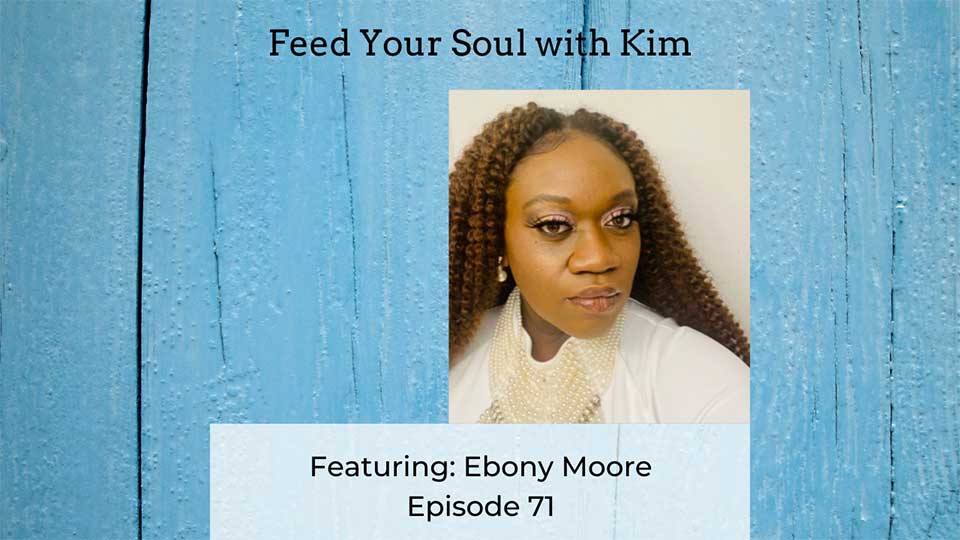
Increase your confidence: an interview with Ebony Moore, Confidence Coach


Increase your confidence: an interview with Ebony Moore, Confidence Coach

Facebooktwitterpinterestlinkedinmail

I had the opportunity to have a conversation with Ebony Moore for the Feed Your Soul with Kim Podcast about confidence. We had met earlier when I was a guest on her podcast BossWife.live.

Ebony talks about confidence through the lens of modeling. She started modeling when she was 12 and now owns a modeling studio.

She talks about starting at Barbizon one of the big top modeling studios. They liked her and wanted to work with her, but they had two options for her: 

  1. She could shave all her my hair off (she was a teen!). Because she always wears her hair towards her face, and she was told it makes her nose look bigger. 
  2. She could get a nose job (she was a teen!). 

Can you image being a teen and told you either needed to shave your hair or get a nose job? She chose neither and started modeling locally. As she started to model locally opportunities began to open in New York, Chicago, and Atlanta. This led to greater self-esteem. 

After getting married at 18 years old she started to have kids and her confidence “took this huge blow, because she had gained weight.” She says she felt like she was “nothing” and her whole identity was wrapped up in her size. 

Ebony acknowledges, “I definitely misplaced my identity, I didn’t lose it, I just misplaced it.” She gave up hope. 

“I felt like my body was just unacceptable, because when you’re not supposed to be overweight.”  Ebony Moore

She started to focus on getting up and getting herself ready and going out. Not staying isolated. Getting up and out helped move her into more confidence. But the change came when she changed her thoughts about herself. 

“It was definitely all mental.” Ebony Moore

Ebony saw how focused we can be on how our bodies look and we lose track of who we really are. We can tend to think who we are is the size and perception of our body.  

How do you move into feeling more confident? 

Start noticing others (ebony noticed it in her kids) experiencing joy in their bodies. 

“I wanted them to know, regardless of who you are, what you like, what your nose looks like, what your hair looks like, you are freaking amazing. Like nobody else in this world looks like you. Watching my children helped me to rebuild my confidence.”

Ebony Moore

Kids can have natural confidence that adults have lost. Ebony talks about noticing the confidence in her kids and the kids in her modeling studio. She saw that she had to give that confidence to herself and then to others. 

Mirror work as a method of confidence building.

In confidence building using the concept of reflecting can be powerful. Ebony does what she calls “mirror sessions” where it’s just you in the mirror. It’s just you, looking back at you. You kind of talk to that person who you used to be.  

Using the mirror to really look at yourself and be ok with yourself. 

Here is her method: 

  • First, get in front of the mirror.
  • Second, look at yourself without make up.
  • Third, look at every mole, every hair that’s out of place, every hair on your chin. What do you like about your ear lobes? Look at your skin, notice the color. 
  • Fourth, take a deep breath and appreciate the beauty of you.  

Love yourself the way you are because that’s who that’s what people are attracted to. People are attracted to you. 

Use mirror work to increase confidence? 

  • First, remind yourself of who you used to be. 
  • Second, imagine going back to being a child. Remember that child-like love for yourself? 
  • Third, what was it about yourself that you loved the most, whether it was your eyes, whether it was your hair, your nose, your lips, whatever your skin color, the shape of your face, that’s the person you need to remember. 
  • Lastly, fast forward to now, what has changed? Recognize that you are the same person. Reconnect with that love for yourself. 

Now that you have reconnected with your true self, ask yourself, “How do I need to be there for me today?” We know you will be there for everybody else. How you need me to be there for you?

We put out the caring for others, but how are you showing up for yourself? 

When we start looking at ourselves in this way we are moving beyond confidence into “Who am I?” This way of looking at ourselves becomes spiritual, and, and mindful. 

How do you increase confidence daily?

Ebony recommends you send yourself an automatic text message daily to encourage yourself. 

Some of her confidence texts are: 

  1. Ebony, how can I be here for you today? 
  2.  Ebony, I need you to be strong for me today. 
  3. Ebony. I need for you to go the extra mile for me today.

Ebony recommends you can open the text at various times of the day to bring yourself back into that place of confidence. 

Increased confidence is a game changer in life. Try some of her tips and let us know how it works in the comments below. 

Check out my recent podcast with Ebony Moore and learn more about her confidence coaching and modeling studio at: 

www.Bosswife.live

www.purposefulthinking360.com

www.enchantedreflectionsstudio.com

https://spreaker.page.link/pW9szrANrXs3Yc2E8

https://www.linkedin.com/in/ebony-moore-1ba58984/


Kim McLaughlin, MA is a Counselor, Speaker, Podcaster, and Inspirational Coach who specializes in working with people who suffer from binge eating and emotional eating. She is a Certified Intuitive Eating Counselor. She is the author of the book Feed Your Soul Nourish Your Life! A Six Step System to Peace with Food and the Amazon #1 Best Selling book Discovery Your Inspiration

You can find Kim on her podcast Feed Your Soul with Kim and you can find it on all podcast platforms. 

Wondering if you are an emotional eater? Sign up for the free Am I an Emotional Eater Quiz. 
10 Life lessons from the time of COVID

10 Life lessons from the time of COVID

Facebooktwitterpinterestlinkedinmail

After the last 15 months of closure, a lot of the world is opening. We can try on clothes in the store, go to the movies, and gather to worship. Are you ready? No matter where you fall on your opinions about the pandemic, I think everyone has a takeaway or life lesson coming out of this last 15 months. If you have not considered your takeaways, this list is going to be a reminder of what you can take from the last 15 months into the future. I call it making lemonade out of lemons.

1. We are more social than we think we are and there is still a necessity for down time. The time of covid was an introvert’s delight. There was a permission to sit and just be. But I heard from many introverts that did want more freedom to go out. I am an extrovert, and I missed all the public places I had gone and the people I could not see. Even though I missed the time out with others, I found I cherished the downtime where I was not expected to be anywhere. Holidays at home and no requirement to drive anywhere felt freeing to me. 

2. There is an interconnectedness to this world.
As I heard the stories of sadness, loss, and fear, I found it so extraordinary to hear my clients and others share feelings and experiences I was experiencing at the same time with them. I felt powerless to make big changes and sitting with the feelings was my call to action often. People in the helping profession are not usually experiencing the same experience at the same time as their clients. This was profound. I had to make a conscious decision to more connected to my self-care than ever.

3. We do not always know what curve balls life will throw us.
My family and I thought we had the year 2020 planned when the clock struck midnight and the new year began. We entered 2020 with a feeling of exuberance and joy. We had so many plans for the year. We dubbed it the “year of the McLaughlin’s.” I had heard so many of my friends express the same excitement for 2020 and saw it as a turning point year. The curve ball is my metaphor when life does not go the way I planned or expected. Once the year began to roll out, it was clear 2020 would not look like what any of us thought.

4. Be grateful for what you have.
As I sat home with my family, I was grateful that I had my husband and child here and my parents close by. I know of people who had some many different experiences, either feeling alone or being around too many people for too long.

5. Food is comforting.
We know food is comforting, but the world experienced food as comfort. I felt scared when I went to the grocery store and saw the shelves empty of food. I have never lived in a place where there was food scarcity, and this is what I experienced. We never actually went without food, but my empathy increased for people who do experience the lack of food.

6. Movement is critical.
I sat- a lot. My family and I walked most every day to get out of the house and to get fresh air and to have movement. I found working from home created more time of sitting and my body hurt. My gym was closed, and they had virtual exercises. I tried to engage virtually, but I did not push myself like I do at the gym. I was grateful when the gym “opened” in early summer at the park. We were able to work out together and stay socially distanced. I realized that I need the social experience of movement to push myself to do more.

7. Routines are important- no matter what.
The pandemic brought this lack of centeredness for myself, my family, and my clients. We did not necessarily have to keep to schedules because life felt upside down. Working from home and virtual school created different routine patterns and I expected less from myself. Sleep was off, food routines were off, and general life was off balance. Once I realized that having a routine no matter what was essential, life became more in balanced.

8. We can adapt to difficult situations, and we are resilient.
I worried about my daughter’s school closing. I did not know how she could get the education she needed. I knew my husband and I were not equipped to be her teachers. It took time, but her school figured out how to have quality virtual classes. We were able to set up a routine for her where she was not on a device all day. She had a lot of virtual playdates where she and her friends make DIY projects, talked, and played games.

9. You do not know when your last day on earth will be, cherish the people and the moments.
This was a tough year. We had a few family members who made their transition during the time of COVID, but they did not die of COVID. Actually, we knew only a very few people close to us who got COVID and no one who was extremely sick with it. I heard many stories of loved ones who died of COVID or got extremely sick. There was and is much pain with the loss of so many lives over a relatively short period of time. I was reminded that death can give us a different perspective on life and to appreciate the moments, no matter what they look like.

10. No matter what, kindness is the key.
Lastly, kindness matters. It really does. I felt so grateful for the doctors and nurses who were on the front lines and did their best to assist as many people as possible. I had more psychotherapy clients want sessions than I could assist. People were feeling the stress, loneliness, and fear. I felt it was an honor to help people during this really difficult time. I had such regard for those who kept working at the grocery stores and made sure we could all get the food and essentials we needed. It was a time of helping neighbors and strangers. We were all going through this shared experience that bonded us together.


I do not know what the future will hold, and I am grateful to be healthy and incredibly grateful my daughter was able to go back to school. My gym is open, and I love my workouts and do not take them for granted.  

I am embracing the lessons from the time of COVID, and I strive to not forget them. I feel changed in a way that is hard to describe.

 Kim McLaughlin, MA is a Counselor, Speaker, Podcaster, and Inspirational Coach who specializes in working with people who suffer from binge eating and emotional eating. She is a Certified Intuitive Eating Counselor. She is the author of the book Feed Your Soul Nourish Your Life! A Six Step System to Peace with Food and the Amazon #1 Best Selling book Discovery Your Inspiration

You can find Kim on her podcast Feed Your Soul with Kim and you can find it on all podcast platforms. 

Determine if you are an Emotional Eater by signing up for the free Am I an Emotional Eater Quiz at https://go.feedyoursoulunlimited.com/emotionaleatingquiz-fysu

Finding Happiness: Be serious about play

Finding Happiness: Be serious about play

Facebooktwitterpinterestlinkedinmail

I have been creating a whole podcast and blog series on the book The Happiness Project by Gretchen Rubin (you can find the companion Feed Your Soul with Kim podcast here.) Each month Gretchen takes on a topic related to happiness. She talks about being serious about play. I find it interesting that we would talk about being serious about play when play is about being fun and not serious. I have found in my adulthood that I do not necessarily take time to have play and to commit to the effort to it. I did not say do not have time for play, I said I do not make time for play. There is a difference, and I can get stuck in work and what I have to do. For me, it does take effort to remind myself that I need to be in this matter of play.

How can we be serious about play AND make it a priority?

1. First, we need to find more fun. The starting point I think is to find what is fun and to have more of it. As adults seriousness creeps and that can suck the life out of the fun.

Gretchen encourages us to asked ourselves to ask ourselves,
“what is fun for me?”  She goes into depth about is finding what is fun for you, not what you think should be fun.

She talks about thinking she had to have fun in to way others have fun, like playing chess, getting a pedicure, etc. She realized that it was no fun to have to model our fun after what we THINK should be fun. I encourage you to determine what is fun for you. One way I suggest is reminding yourself that what you did do for fun in the past. Thinking about what I used to do in the past for fun brings up good memories and ideas for me that has been listening to musical theater, collaging and going to the library.

2. Second, Gretchen encourages us to take time to be silly. Being silly can be tough to do in this fast-paced world. Find laughter can be illusive, especially in this year+ of COVID 19. Gretchen talks about silliness being contagious. The phenomenon of “emotional contagion” where you unconsciously pick up emotions from others. Good mood brings out good moods and others.

3. Third, she talks about starting a collection as a way of having fun. I thought this idea a little silly until I realized that I have a collection of dragonfly items that I love. I love to search for the perfect dragonfly item to add to my collection. My collection goes so deep that I got a dragonfly tattoo on my forearm. It brings me joy to see dragonflies and see my dragonfly collection.

4. Fourth, she talks about going off the path, which means to me to do something new, unexpected, and different. Ideas for play are endless and a starting spot can be to do what you used to do for play.  

————————————————————————————–

I keep list of what are new things I would like to do. I actually have a list of 100 things I would like to do. Going of the path and doing something new can mean being uncomfortable, but it could be well worth it. I do yoga every week and sometimes the poses are well out of my comfort zone. Every time I try a new pose, I feel satisfied. Truthfully, I never thought I would have called anything physically fun, but the workouts I do provide an atmosphere of fun. Getting out of my comfort zone physically is one of the ways of going off the path, for me.

I encourage you to consider how you can go off the path and find something new. This past year+ during the time of COVID 19 we all had to go off the path and it was often not fun. Now I am ready to add more fun in and am excited to explore this idea. 

It is easy to go off the path by simply exploring your neighborhood, walk a different way, go in a different direction down grocery aisles. These are daily easy ways to go off the path. I encourage you to make a list of what you can do for fun and start DOING it. Increasing fun is a fantastic way to increase happiness

Kim McLaughlin, MA is a Counselor, Speaker, Podcaster, and Inspirational Coach who specializes in working with people who suffer from binge eating and emotional eating. She is a Certified Intuitive Eating Counselor. She is the author of the book Feed Your Soul Nourish Your Life! A Six Step System to Peace with Food and the Amazon #1 Best Selling book Discovery Your Inspiration

You can find Kim on her podcast Feed Your Soul with Kim and you can find it on all podcast platforms. 

Determine if you are an Emotional Eater by signing up for the free Am I an Emotional Eater Quiz at https://go.feedyoursoulunlimited.com/emotionaleatingquiz-fysu

How to Find Happiness

How to Find Happiness

Facebooktwitterpinterestlinkedinmail

Could you use more happiness? Is there actually a way to be happier? 

In Gretchen Rubin’s book, The Happiness Project, she challenges us to look at happiness and see what we can do to boost it. Gretchen engages her readers in different concepts each month to build a stronger foundation of happiness.

In her first chapter, she focuses on how to find happiness. Her happiness project is fun and helps us explore the idea of happiness and how to increase it. 

Happiness is the state of being happy, a feeling or showing pleasure or contentment. Do you know that 1.2 billion people are looking up happiness on the internet? This tells me that lots of people are trying to find more happiness.

Not sure how happy you really are? One way to determine your happiness is to take the Subjective Happiness Scale (Lyubomirsky, S., & Lepper, H).
Subjective Happiness Scale

For each of the following statements and/or questions, please circle the point on the scale that you feel is most appropriate in describing you. 

  1. In general, I consider myself: 

1     2     3     4     5     6    

Not very happy                 very happy  

  1. Compared to most of my peers, I consider myself: 

1     2     3     4     5     6    

Less happy                     more happy 

  1. Some people are generally very happy. They enjoy life regardless of what is going on, getting the most out of everything. To what extent does this characterization describe you? 

1     2    3     4     5     6    

Not happy at all                 Very happy 

  1. Some people are generally not very happy. Although they are not depressed, they never seem as happy as they might be. To what extent does this characterization describe you? 

1     2     3     4     5     6    

Not at all                     a great deal.

*Lyubomirsky, S., & Lepper, H. (1999). A measure of subjective happiness: Preliminary reliability and construct validationSocial Indicators Research, 46, 137-155. The original publication is available at www.springerlink.com.

Taking that quiz can be an eye opener to how happy you are. How did you score? Did you notice in some ways you are not happy or not as happy as you want to be?

Gretchen Rubin spends time in each of her chapters looking at how to increase happiness. I think you will find the ideas presented are helpful to boost happiness.

One way to increase happiness is to boost your energy, which entails increasing some basic shifts in your life.

First, go to sleep earlier.

Focus on getting 8 hours of sleep. Truthfully, many of us are sleep deprived. Here are some ways to get better sleep:

  1. Turn off electronics.
  2. Make the room dark.
  3. Keep the room cold. 

Second, exercise better (this is a term Gretchen uses)

She talks about being more efficient in your exercise/movement. I am really a just do it kind of girl. There are many hacks I try to use: 

  1. First, I call it movement. I find many people are turned off to “exercising” because they have felt so much shame over their lives about their weight and body image. 
  2. Second, I put it in my calendar. I actually have my gym time in my schedule. I find it is hard skipping a day when it is in my calendar.
  3. Third, my movement is fun. Yes, it is fun. I make it a goal to find movement that is enjoyable. We are physical beings in a physical body that does require us to have some form of movement. Do what is fun!

Third, get rid of the clutter: toss, restore, organize:

Look around and see what type of clutter you have. 

  1. Nostalgic clutter 
  2. Conservation clutter 
  3. Nostalgic clutter
  4. Bargain clutter
  5. Freebie clutter
  6. Crutch clutter 
  7. Aspirational clutter
  8. Outgrown clutter
  9. Buyer’s remorse clutter

This clutter can make you feel energetically stuck. See where your clutter is and find a way to either toss, restore or organize. You will feel more energy from it.

Fourth, tackle a nagging project.

What is an unfinished task that is nagging at you? We all have them and they help us to remain energetically stuck. I have some craft project that I either need to finish or get rid of. What about you?

Fifth, just act more energetic.

Putting out energy or effort does increase energy. I find action creates more action. It is a physical phenomenon. 

Lastly, listen to the Feed Your Soul with Kim podcast focused on Finding Happiness

https://www.buzzsprout.com/1056343/3583681-36-finding-happiness

Getting happier is a goal I can get behind. It makes me feel good. What can you do today to get happier? 

Kim McLaughlin, MA is a Counselor, Speaker, Podcaster and Inspirational Coach who specializes in working with people who suffer from binge eating and emotional eating. She is a Certified Intuitive Eating Counselor. She is the author of the book Feed Your Soul Nourish Your Life! A Six Step System to Peace with Food and the Amazon #1 Best Selling book Discovery Your Inspiration

You can find Kim on her podcast Feed Your Soul with Kim and you can find it on all podcast platforms. 

Determine if you are an Emotional Eater by signing up for the free Am I an Emotional Eater Quiz at https://go.feedyoursoulunlimited.com/emotionaleatingquiz-fysu