
Finding Happiness: Be serious about play

Finding Happiness: Be serious about play


Facebooktwitterpinterestlinkedinmail

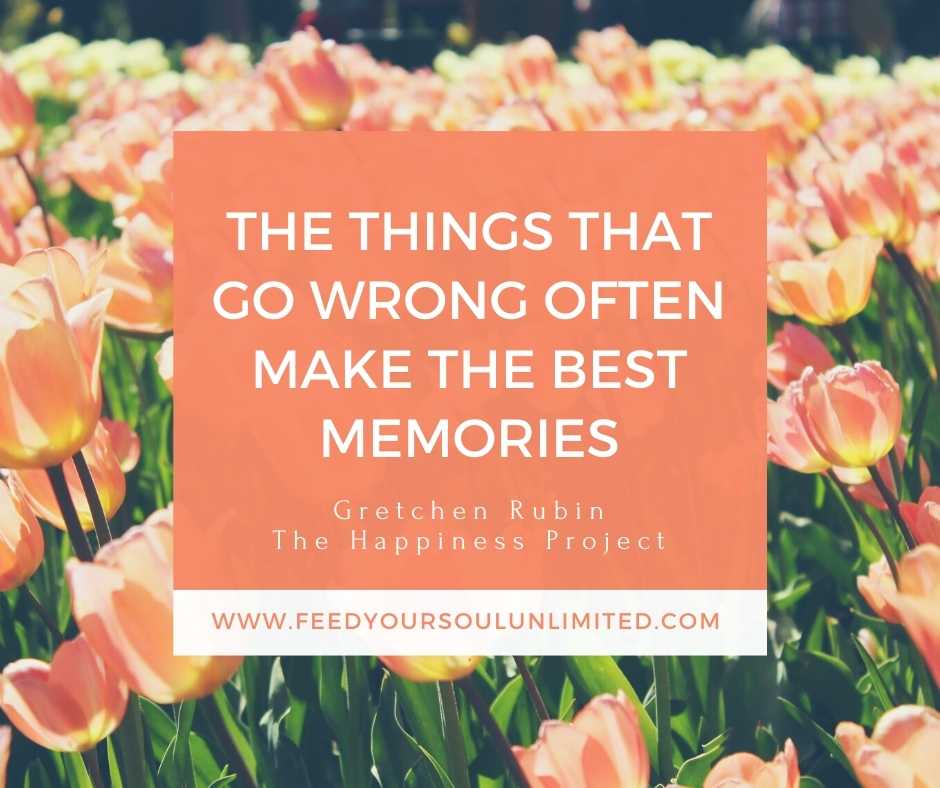
I have been creating a whole podcast and blog series on the book The Happiness Project by Gretchen Rubin (you can find the companion Feed Your Soul with Kim podcast here.) Each month Gretchen takes on a topic related to happiness. She talks about being serious about play. I find it interesting that we would talk about being serious about play when play is about being fun and not serious. I have found in my adulthood that I do not necessarily take time to have play and to commit to the effort to it. I did not say do not have time for play, I said I do not make time for play. There is a difference, and I can get stuck in work and what I have to do. For me, it does take effort to remind myself that I need to be in this matter of play.

How can we be serious about play AND make it a priority?

1. First, we need to find more fun. The starting point I think is to find what is fun and to have more of it. As adults seriousness creeps and that can suck the life out of the fun.

Gretchen encourages us to asked ourselves to ask ourselves,
“what is fun for me?”  She goes into depth about is finding what is fun for you, not what you think should be fun.
She talks about thinking she had to have fun in to way others have fun, like playing chess, getting a pedicure, etc. She realized that it was no fun to have to model our fun after what we THINK should be fun. I encourage you to determine what is fun for you. One way I suggest is reminding yourself that what you did do for fun in the past. Thinking about what I used to do in the past for fun brings up good memories and ideas for me that has been listening to musical theater, collaging and going to the library.

2. Second, Gretchen encourages us to take time to be silly. Being silly can be tough to do in this fast-paced world. Find laughter can be illusive, especially in this year+ of COVID 19. Gretchen talks about silliness being contagious. The phenomenon of “emotional contagion” where you unconsciously pick up emotions from others. Good mood brings out good moods and others.

3. Third, she talks about starting a collection as a way of having fun. I thought this idea a little silly until I realized that I have a collection of dragonfly items that I love. I love to search for the perfect dragonfly item to add to my collection. My collection goes so deep that I got a dragonfly tattoo on my forearm. It brings me joy to see dragonflies and see my dragonfly collection.

4. Fourth, she talks about going off the path, which means to me to do something new, unexpected, and different. Ideas for play are endless and a starting spot can be to do what you used to do for play.  

————————————————————————————–

I keep list of what are new things I would like to do. I actually have a list of 100 things I would like to do. Going of the path and doing something new can mean being uncomfortable, but it could be well worth it. I do yoga every week and sometimes the poses are well out of my comfort zone. Every time I try a new pose, I feel satisfied. Truthfully, I never thought I would have called anything physically fun, but the workouts I do provide an atmosphere of fun. Getting out of my comfort zone physically is one of the ways of going off the path, for me.

I encourage you to consider how you can go off the path and find something new. This past year+ during the time of COVID 19 we all had to go off the path and it was often not fun. Now I am ready to add more fun in and am excited to explore this idea. 

It is easy to go off the path by simply exploring your neighborhood, walk a different way, go in a different direction down grocery aisles. These are daily easy ways to go off the path. I encourage you to make a list of what you can do for fun and start DOING it. Increasing fun is a fantastic way to increase happiness

Kim McLaughlin, LMFT, psychotherapist, speaker, author, and host of the Feed Your Soul with Kim podcast. Kim helps high-achieving women improve their mental health, overcome emotional eating and binge eating, reduce anxiety, and create more joy and fulfillment in their lives. She offers online therapy throughout California and in-person counseling in Roseville, CA.

Schedule a free 20-minute consultation here. https://kim-mclaughlin.clientsecure.me/
 

Finding Happiness: Lighten Up

Finding Happiness: Lighten Up

Facebooktwitterpinterestlinkedinmail

I love Gretchen Rubin’s book The Happiness Project each month she tackles a topic to help us improve our happiness. She outlines tasks that are scientifically proven to increase happiness. Each month we have looked at the suggestions she has made to increase happiness and see how we can do it for ourselves.

After this last year of the pandemic, all our escapes to find “happiness” had been taken away and now we have been poised to look internally.

Gretchen talks about focusing on becoming more playful and she relates it in the context of being with her children. I want to focus further out then seeing playfulness with just children. I know some of you do not have children or your children are grown.

Gretchen Rubin in The Happiness Project encourages us to look at some new methods to increase happiness:

1. Sing in the Morning- 

I find this interesting since I remember when I was a teen, the mom of a friend of mine would play the radio in the morning as they were getting ready.

I remember it felt so soothing to have music going in the morning.

During the pandemic, I had been listening to more music and especially listening to more musical theatre recordings. It is so uplifting to have music playing. Yes, I do put it on and sing, which is half of the fun. It thoroughly embarrasses my daughter.

Gretchen introduces us to the idea of having a “sing in the morning” frame of mind. I think this enables us to be less stressed at any point in the day.

2. Acknowledge the Reality of People’s Feelings

This is a classic truth about communication 101. 

People can tend to tell you…

  • “You do not feel the way.” 
  • “You shouldn’t feel that way.”
  • “Get over it.” 

Over this last year, we have been in close proximity to the people we live with and there have been less outlets for feelings. We had been asked to not see people, I know we are getting back to seeing people now, but the trauma of this last year lingers.

I work with my clients on effective communication and one sure technique to help manage a situation, is to just acknowledge how the other person feels. No judgment, just acknowledge it. This is powerful.

Allow the other person to be with their feelings, listen to them and acknowledge you hear them. Man, often, we just want to be heard. You do not have to do any more than that. 

  1. Be a Treasure House of Happy Memories

Gretchen says it is important to, “Keep happy memories vivid.” She says studies show that recalling happy times helps boost happiness in the present. I call them, “remember when’s.” Remember when’s bring back the joy of the time. This is why looking at old pictures is so important. It reminds us of the fun we had. We then share stories and this enlivens everyone. 

Keeping up with family members to let them know how you are doing as well as connecting is critical. These people you have spent years of connecting with are important.

Gretchen talks, also, about the importance of family traditions. There is familiarity and excitement with the traditions. Last year, many holidays fell during the time of the pandemic. Many of you like me and my family decided to forgo our traditions to shelter in place. We made some new family traditions to make the holidays special. It was kinda fun to have holiday get togethers over Zoom. 

What are you going to do to increase your happiness? I just gave you at least three ideas today. We are still in a time of transition as we move back into having gatherings.  How we move through this time will have an effect on how well we transition out of it. There is room to be happy in tough times. The flowers are blooming, the sun is shining and there are blessings all around. Happiness is all around us if we decide to find it.

Kim McLaughlin is a psychotherapist in california. Providing therapy services to high achieving women.

Kim McLaughlin, LMFT, psychotherapist, speaker, author, and host of the Feed Your Soul with Kim podcast. Kim helps high-achieving women improve their mental health, overcome emotional eating and binge eating, reduce anxiety, and create more joy and fulfillment in their lives. She offers online therapy throughout California and in-person counseling in Roseville, CA.

Schedule a free 20-minute consultation here. https://kim-mclaughlin.clientsecure.me/

How to Find Happiness

How to Find Happiness

Facebooktwitterpinterestlinkedinmail

Could you use more happiness? Is there actually a way to be happier? 

In Gretchen Rubin’s book, The Happiness Project, she challenges us to look at happiness and see what we can do to boost it. Gretchen engages her readers in different concepts each month to build a stronger foundation of happiness.

In her first chapter, she focuses on how to find happiness. Her happiness project is fun and helps us explore the idea of happiness and how to increase it. 

Happiness is the state of being happy, a feeling or showing pleasure or contentment. Do you know that 1.2 billion people are looking up happiness on the internet? This tells me that lots of people are trying to find more happiness.

Not sure how happy you really are? One way to determine your happiness is to take the Subjective Happiness Scale (Lyubomirsky, S., & Lepper, H).

Subjective Happiness Scale

For each of the following statements and/or questions, please circle the point on the scale that you feel is most appropriate in describing you. 

  1. In general, I consider myself: 

1     2     3     4     5     6    

Not very happy                 very happy  

  1. Compared to most of my peers, I consider myself: 

1     2     3     4     5     6    

Less happy                     more happy 

  1. Some people are generally very happy. They enjoy life regardless of what is going on, getting the most out of everything. To what extent does this characterization describe you? 

1     2    3     4     5     6    

Not happy at all                 Very happy 

  1. Some people are generally not very happy. Although they are not depressed, they never seem as happy as they might be. To what extent does this characterization describe you? 

1     2     3     4     5     6    

Not at all                     a great deal.

*Lyubomirsky, S., & Lepper, H. (1999). A measure of subjective happiness: Preliminary reliability and construct validationSocial Indicators Research, 46, 137-155. The original publication is available at www.springerlink.com.

Taking that quiz can be an eye opener to how happy you are. How did you score? Did you notice in some ways you are not happy or not as happy as you want to be?

Gretchen Rubin spends time in each of her chapters looking at how to increase happiness. I think you will find the ideas presented are helpful to boost happiness.

One way to increase happiness is to boost your energy, which entails increasing some basic shifts in your life.

First, go to sleep earlier.

Focus on getting 8 hours of sleep. Truthfully, many of us are sleep deprived. Here are some ways to get better sleep:

  1. Turn off electronics.
  2. Make the room dark.
  3. Keep the room cold. 

Second, exercise better (this is a term Gretchen uses)

She talks about being more efficient in your exercise/movement. I am really a just do it kind of girl. There are many hacks I try to use: 

  1. First, I call it movement. I find many people are turned off to “exercising” because they have felt so much shame over their lives about their weight and body image. 
  2. Second, I put it in my calendar. I actually have my gym time in my schedule. I find it is hard skipping a day when it is in my calendar.
  3. Third, my movement is fun. Yes, it is fun. I make it a goal to find movement that is enjoyable. We are physical beings in a physical body that does require us to have some form of movement. Do what is fun!

Third, get rid of the clutter: toss, restore, organize:

Look around and see what type of clutter you have. 

  1. Nostalgic clutter 
  2. Conservation clutter 
  3. Nostalgic clutter
  4. Bargain clutter
  5. Freebie clutter
  6. Crutch clutter 
  7. Aspirational clutter
  8. Outgrown clutter
  9. Buyer’s remorse clutter

This clutter can make you feel energetically stuck. See where your clutter is and find a way to either toss, restore or organize. You will feel more energy from it.

Fourth, tackle a nagging project.

What is an unfinished task that is nagging at you? We all have them and they help us to remain energetically stuck. I have some craft project that I either need to finish or get rid of. What about you?

Fifth, just act more energetic.

Putting out energy or effort does increase energy. I find action creates more action. It is a physical phenomenon. 

Lastly, listen to the Feed Your Soul with Kim podcast focused on Finding Happiness

https://www.buzzsprout.com/1056343/3583681-36-finding-happiness

Getting happier is a goal I can get behind. It makes me feel good. What can you do today to get happier? 

Kim McLaughlin, MA is a Counselor, Speaker, Podcaster and Inspirational Coach who specializes in working with people who suffer from binge eating and emotional eating. She is a Certified Intuitive Eating Counselor. She is the author of the book Feed Your Soul Nourish Your Life! A Six Step System to Peace with Food and the Amazon #1 Best Selling book Discovery Your Inspiration

You can find Kim on her podcast Feed Your Soul with Kim and you can find it on all podcast platforms. 

Determine if you are an Emotional Eater by signing up for the free Am I an Emotional Eater Quiz at https://go.feedyoursoulunlimited.com/emotionaleatingquiz-fysu

Wellness Tool #2 Journaling with prompts

Wellness Tool #2 Journaling with prompts

Facebooktwitterpinterestlinkedinmail

After blogging and podcasting about journaling as a wellness tool, I started to journal more! I find that when I start to talk about a tool, I tend to use them more myself. 

The technique I spoke about was a favorite journaling tool called Morning Pages.

I learned about this tool years ago through the work of Julia Cameron in her book The Artist Way she describes one of her daily practices called The Morning Pages. 

Here are some basic tenants to the practice:

  • Write in your journal daily.
  • Write 3 pages in your journal.
  • Handwritten journaling, no computer
  • Write upon waking, in the morning.
  • Write without stopping: no cross outs, no need for accurate punctuation, just keep the pen moving.

Today, I want to talk about another journaling practice that I love which is more of a creative writing process that I learned from writing retreats that I have taken with Laura Davis. Laura is an extraordinary writer and cowrote the seminal book on childhood sexual abuse called The Courage to Heal.

Here are some writing guidelines that I learned from retreats with Laura and from other sources:

Here are some ways to get started:

  • First, your journal does not have to be pretty. I have been known to buy very inexpensive spiral bound journals at the local store. I like them because they are spiral bound, and I can turn the pages easily. This is important to me, because I like to write with one page in front of me and these journals fold into one side. I have a harder time journaling on a hard bound journal where the two sides are open.   
  • Second, keep your inner thinking private. I make it clear to my family that my journal is private and they do not open it. I want to be able to put out all that I am thinking, and I do not want to have to temper what I say. This is not a journal that I plan to share with others.  
  • Thirdly, set a really small reasonable period of time to write, 10 minutes, everyone has 10 extra minutes. Laura Davis introduced me to the 10-minute writing idea. It is a short period of time and you really can express A LOT in that amount of time. She also encouraged us to keep the pen moving and keep writing.   
  • Lastly, you do not need to share everything you write with friends, spouse or family. This is your private inner life that does not, necessarily need to be shared.  

One of the greatest gifts I received from my writing retreats with Laura Davis was learning to just write the worst crap ever written. I found that was so freeing and my number one rule when I write in my journal.

I find that writing allows me access to the deeper and positive parts of myself. 

One technique that Laura taught was journaling through answering a question. The idea is you take one question and answer it until nothing else come to you. Then you start a new paragraph and write the question again and answer it until nothing else comes. Then you write the question again and keep writing until nothing else comes to you. 

This pattern of answering the question on different paragraphs took me to a deeper level of myself.

Here are some examples of questions you could use in your journaling:

  • I feel most free when I…
  • I am most afraid…
  • My fears keep me from…
  • I love myself most when I…
  • My childhood kitchen was…

This type of journaling is different than others and brings up greater self-awareness, which for me is why I journal. 

Once I got over the idea that my writing had to be written with others in mind, I felt freer to just write and explore what was inside of me. I encourage you to try this style of journaling and see what it does for you. 

Kim McLaughlin, MA is a Counselor, Speaker, Podcaster and Inspirational Coach who specializes in working with people who suffer from binge eating and emotional eating. She is a Certified Intuitive Eating Counselor. She is the author of the book Feed Your Soul Nourish Your Life! A Six Step System to Peace with Food and the Amazon #1 Best Selling book Discovery Your Inspiration

You can find Kim on her podcast Feed Your Soul with Kim and you can find it on all podcast platforms. 

Determine if you are an Emotional Eater by signing up for the free Am I an Emotional Eater Quiz at https://go.feedyoursoulunlimited.com/emotionaleatingquizfysu

Good Morning Starshine- Morning Routine

Good Morning Starshine- Morning Routine

Facebooktwitterpinterestlinkedinmail

This week I am considering how we start our day. 

As I reflected on my morning routine, I realized there are some basics to the routine that are important to me. The days I accomplish this morning routine, I feel energized. There are ways I can start my day that leads me to feel sluggish.

First, I am not a purist with how I start my day. I have heard experts and “high achievers” talk about how they start their day, and it sounds so great to me, but I am not able to achieve that mark daily. 

I have heard about meditating for an hour, getting up earlier, exercising first thing in the morning or drinking a concoction of warm water and hot spices. I have tried all of these and I do them for a while and do not stick with them. This had made me feel defeated that I could not have this pure morning routine.

What I have learned is there are some key ingredients to the morning that do make me feel good and get me started in the right way.

  1.  Wake up around the same time every day. This also means I need to go to bed around the same time every night. I have tried to wake up much earlier because I heard it was a great way to start the day. That does not work long term for me. I love my sleep. I have learned that allowing myself to sleep too late is a sign that I am off track and I need to look at rebalancing my life.
  2. I like coffee it the morning. I love the smell, taste, the warm mug. I do not require caffeine, so generally it is decaf. I find that a lot of caffeine through the day does not make me feel good. I do drink more than one cup of coffee!
  3. I have a comfy spot you will find me sitting in most mornings.
  4. I do look at my emails first thing in the morning. I have heard guru after guru state not to look at your phone until work or after breakfast. I like to see what messages are coming in and respond to anything urgent. This works for me, consider what works for you.
  5. I also check the news and see what has happened while I was asleep.
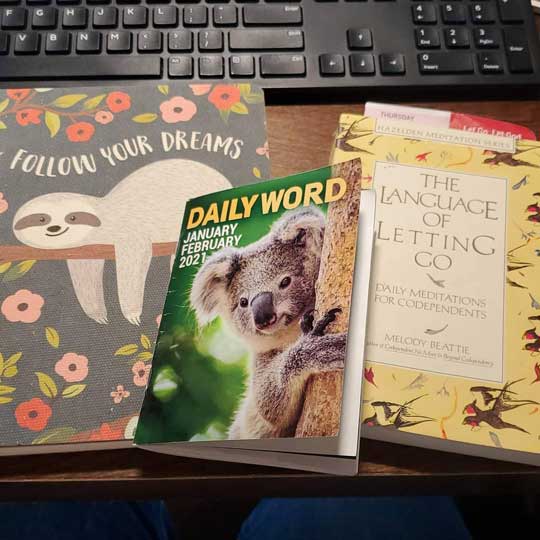
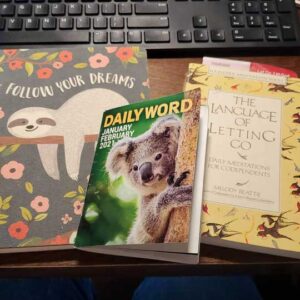
  6. I read the Daily Word, which is a small daily devotional book that inspires me. The Daily Word also gives me a point to close my eye and meditate. I take some moments to consider what is written and how it relates to me. Some days I add in longer meditation when the house is quiet. I either use the quote from the Daily Word and contemplate it or I use Insight Timer app and chose a meditation that matches my needs and time available.
  7. I often have more than one inspirational book that I look at in the morning. Right now, I include Codependent No More daily affirmations. It is a great book to look at codependency in a different way. 
  8. Lastly, I get out my journal and I write. I like writing about 3 pages using the Morning Pages format, which is 3 pages long hand without stopping.
  9. In addition, have breakfast. I find I am generally not hungry first thing in the morning, so the coffee works. I find breakfast is crucial to helping me get off to a good start to the day.

Now what do you as part of your morning routine?

Is your morning working for you or not? Consider reimagine your morning and determine what are the components that work for you.

You can listen to this blog on the Feed Your Soul with Kim Podcast. This is one of our most popular episodes. Have a listen…

https://podcasts.apple.com/us/podcast/episode-57-good-morning-starshine-morning-routine/id1473042304?i=1000510571297

Kim McLaughlin, LMFT, psychotherapist, speaker, author, and host of the Feed Your Soul with Kim podcast. Kim helps high-achieving women improve their mental health, overcome emotional eating and binge eating, reduce anxiety, and create more joy and fulfillment in their lives. She offers online therapy throughout California and in-person counseling in Roseville, CA.

Schedule a free 20-minute consultation here. https://kim-mclaughlin.clientsecure.me/


Leaning Into Your YES!

Facebooktwitterpinterestlinkedinmail

Did you know that “Yes” is a complete sentence?  We can get stuck wondering what the best avenue is and we enter into the realm of maybe. Should I look for a new job, because I am unhappy where I am? Maybe. Do you want to move to a house that better fits my needs? Maybe. This can be a huge sticking point and we can remain stuck for years.

Kari was an elementary school teacher. She loved her students, but she didn’t find her job fulfilling any longer. As a teenager, she’d always dreamed of traveling around the world and writing novels on her laptop.

She wanted more freedom in her personal and professional life, but she worried. She was afraid of what would happen if she really did start chasing her dreams. She doubted she had the ability to make her dream a reality. She wondered what everyone around her would think if she quit her job and wrote instead.

Kari was stuck in a rut, afraid to say “yes” to her best life. She lived in the “maybe someday” mindset. Possibly you can relate. You spend years daydreaming about what you want your life to look like. Instead of acting, you tuck your dream away quietly and get back to your ordinary world. But before you do that, here are three simple reasons you should lean into your yes…

Reason #1: New Discoveries Are Waiting

Everything you love right now was once an unknown. Your favorite ice cream flavor, your favorite movie, your favorite makeup—all of these things were once unknown to you. But you didn’t let that stop you and tried them anyway.

When you say yes to new discoveries, you learn more about what you like and love. You took a chance and made a bold decision. This doesn’t mean you’ll love the results of every yes you go after. Sometimes, you’ll simply discover what you don’t like. That’s an important discovery, too.

Reason #2: Personal Growth Doesn’t Happen in Your Safety Zone

For some people, saying ‘no’ is an automatic response. You say ‘no’ to that new project even though you know it could lead to a promotion. You say ‘no’ to healthy foods even though you know it could lead to more energy.

Saying maybe, someday, I don’t know is the same as saying no. 

Personal growth never happens inside your safety zone. If you really want to make a difference and change your life, then you have to be willing to do things you’ve never done before. You have to be willing to say yes even when the future feels scary and uncertain.

Reason #3: Say Yes to Learning New Things

Besides growing into your best self, saying yes helps you learn new things. You might say yes to the chance to host a party and discover you love being a hostess. You could say yes to a giving a presentation at work and find out you love public speaking.

What you learn won’t be just limited to your personality though. You’ll also learn more about your relationships, your finances, your health, and so many other areas of your life. Maybe a new dance class makes you realize how supportive your partner is. Maybe an unexpected road trip with an aging parent gives insight into how your mom grew up.

Saying yes can be the beginning of a beautiful new adventure. But don’t feel you have to start out by tackling something big like changing your job or moving to a different country. Instead, start with something small like taking a new class or reaching out to form new friendships. The more you say yes to little things the easier it will become to say yes to the big things.


Kim McLaughlin, MA is a licensed psychotherapist and a motivational coach who works with people who suffer from emotional eating, body image issues, self-esteem and binge eating. She is passionate about helping people feed their soul and put food in its proper place as nourishment. Kim has been a speaker for many groups and she enjoys sharing the message that you can look at food differently. You can find out more about Kim plus get access to her monthly free calls and her Free Report: Top Strategies to End Binge Eating at www.FeedYourSoulUnlimited.com