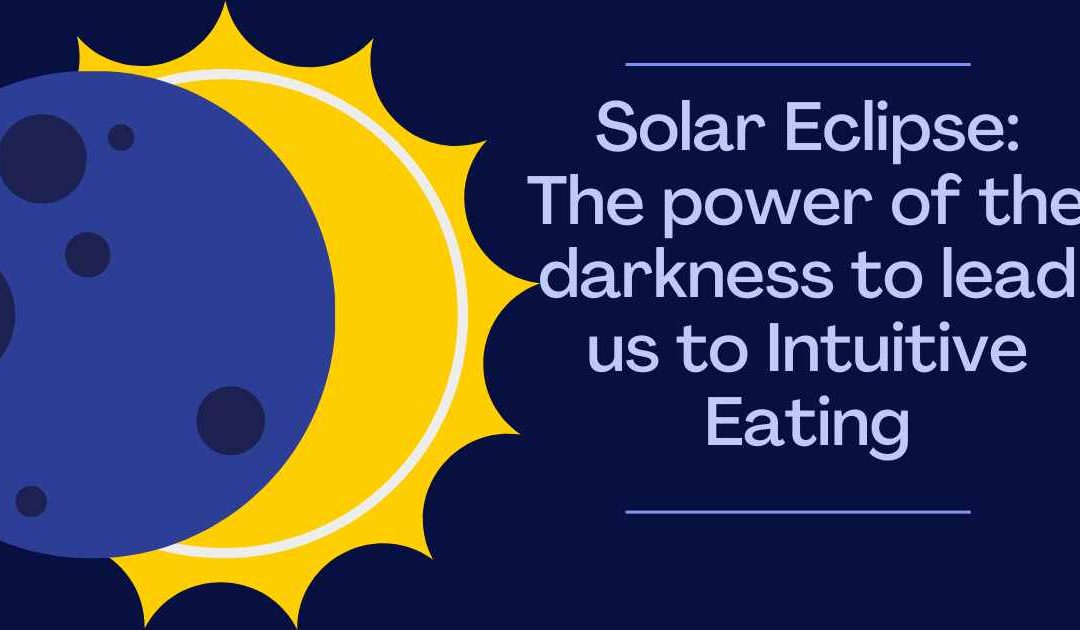
Did know the Solar Eclipse can give us some incredible insights into Intuitive Eating?
Recently, I started to hear about the solar eclipse. Friends of mine traveled to another state just to be in the path of the solar eclipse! I found the on-line Solar Eclipse tracker on-line and tracked its trajectory.
What is a Solar Eclipse?
Solar eclipses occur when the moon passes between the sun and Earth, casting a shadow on our planet. This alignment is a powerful reminder of the intricate dance between different elements in our lives. Just as the moon temporarily obscures the sun’s light, we may experience moments of darkness or struggle in our journey towards intuitive eating and body acceptance.
However, it is important to remember that these moments are transient, just like a solar eclipse. The sun always emerges from behind the moon, shining its light once again.
Similarly, we have the capacity to overcome challenges and emerge stronger in our relationship with food and our bodies.
There is a symbolism of Darkness and Light in overeating!
As in the Solar Eclipse, overeating can lead to a darkness that momentarily envelops us (feeling bad about ourselves). This darkness represents the shadows we often face in our relationship with food – feelings of guilt, shame, or restriction.
However, just as the sun eventually emerges from behind the moon, so too can we find light amidst these shadows.
Intuitive eating encourages us to embrace all aspects of our relationship with food without judgment or restriction. By acknowledging and accepting our dark moments, we can learn from them and pave the way for a more balanced and nourishing approach to eating.
I became even more interested in the power of the Solar Eclipse when my friend, Teresa Campos, offered her community a workshop on the symbolism of the Solar Eclipse. She told us when the moon is between the sun and earth it creates a shadow, which gives us an opportunity to see what shadows are showing up for ourselves. This workshop made me think further about the shadows in our lives around food, overeating and body image.
What are the Shadows in your life with food, body image and overeating?
Where am I struggling with food?
How do I struggle with my body image?
Where is there the lack of forgiveness?
Is there anger at myself or others?
These questions led me to inquire more about what I needed in my life.
The shadows are the undiscovered parts of us that are wanting to break through. The darkness of the eclipse is a metaphor to what shadows are going on in me. I can then move through it and the sun shines fully again.
Embracing Change: Lessons from the Transitory Nature of Solar Eclipses.
One of the most remarkable aspects of a solar eclipse is its transitory nature. It serves as a powerful reminder that change is inevitable and necessary for growth.
In our journey towards intuitive eating and body acceptance, we may encounter changes in our habits, beliefs, and perceptions.
Just like the moon moving across the sun, these changes can be transformative if we embrace them with an open mind and heart. By letting go of old patterns that no longer serve us, we create space for new experiences and a deeper connection with ourselves.
Here are some questions to start wondering about that deeper connection:
Where is there some darkness in my life?
What change is calling me?
Where is my support to make this change?
Finding Balance: Exploring the Relationship Between Sun and Moon in Body Acceptance.
The relationship between the sun and moon during a solar eclipse teaches us about balance. The sun represents our desire for warmth, nourishment, and vitality, while the moon symbolizes our emotions, intuition, and inner world.
Similarly, body acceptance requires finding equilibrium between honoring our physical needs and nurturing our mental well-being. Just as the sun and moon complement each other’s existence, we too can find harmony by embracing both aspects of ourselves – our bodies and minds – in our journey towards self-acceptance.
The Power Within: Using Intuitive Eating to Navigate Challenges.
As we witness the power of a solar eclipse, we are reminded of the immense energy within us waiting to be harnessed.
There are many tools to guide us on this path.
Looking through a positive lens (seeing the light).
Practicing self-compassion (honoring our value).
Building resilience (making pivots to increase our self-esteem).
We can navigate challenges with grace and strength. Just as the moon aligns perfectly with the sun during an eclipse, we too can align our thoughts and actions with our goals for intuitive eating, body acceptance, and mental well-being.
Reflecting on the lessons learned from solar eclipses, what can you apply to your own journey towards intuitive eating, body acceptance, and mental well-being?
Take a moment to journal or meditate on what changes you are ready to embrace and how you can find balance in your relationship with food and your body.
Consider seeking support from professionals or joining a community that aligns with your goals for further guidance and encouragement. You can join us in the Feed Your Soul Communityon Facebook.
We would love for you to join us in Emotional Eating Solutions, our course to help you move into peace with food through Intuitive Eating.
There I said it. I think exercising is ridiculous.
My clients often tell me they, too, do not want to exercise. They often ask me why they do not want to exercise. They know it is “good” for them, but they are unmotivated.
My clients are motivated to exercise when they start a diet. Once they stop losing weight and stop the diet, the exercise stops.
Aren’t we all supposed to want to exercise?
You can look up the many meanings of exercise in the dictionary and I am going to go for the common definition.
Merriam-Webster says physical exercise is:
The regular or repeated use of a faculty or bodily organ.
Bodily exertion for the sake of developing and maintaining physical fitness.
I have always thought exercise is something that I am supposed to want to do. I am supposed to want to be “physically fit,” whatever that might mean. I, and many of my clients, do not resonate with the idea of exercise.
There are some powerful reasons not to want to exercise:
Exercise is connected to the dieting cycle of restrict, binge, shame.
It can be hard and uncomfortable. Anyone who’s heard the term, “no pain, no gain” could agree.
You sweat A LOT, which can lead to embarrassment about your size.
Exercise can bring back the feelings from younger years of being shamed in P.E. class.
Your body is exposed through tight clothes. Gyms have LOTS of mirrors.
The ongoing judgment of yourself not being able to perform a physical task.
Exercise is connected to dieting: when I am on a diet, I exercise and when I am off the diet, I stop exercising.
The list of why we do not exercise is long. When we have a history of eating disorders and disordered eating, there is plenty of baggage with exercise.
When my clients ask, why should I exercise? I respond you shouldn’t exercise.
Shocking right?
Even though exercise is loaded with baggage, we are in bodies and need to engage in movement.
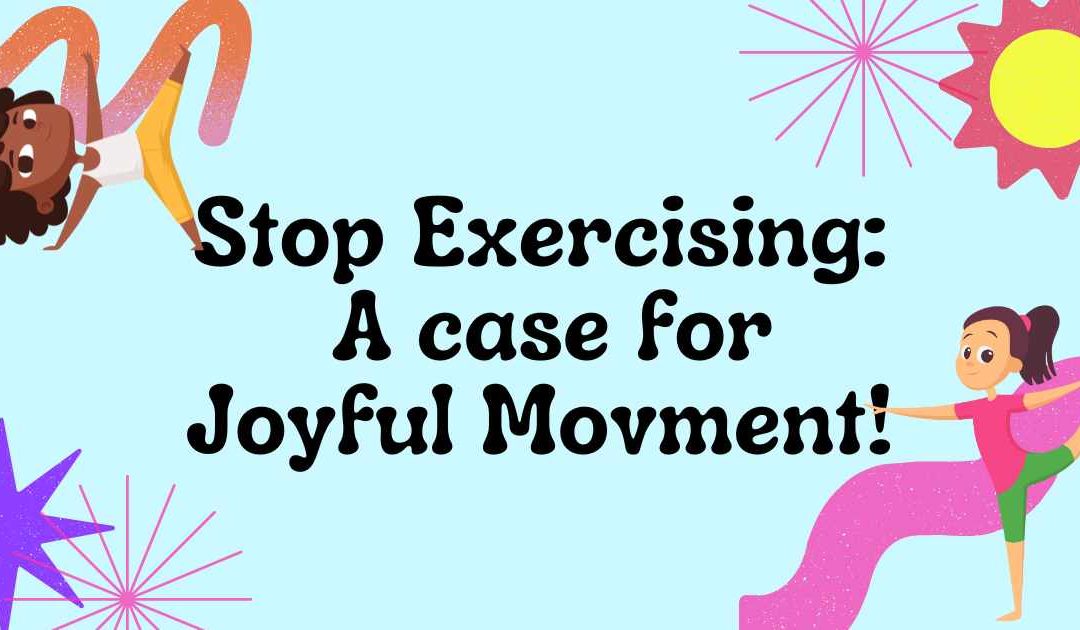
In Intuitive Eating we call it joyful movement.
We are meant to move our bodies in the way that works best for each of us. Everyone has a different level of capacity and ability.
Do what movement YOU can do.
We know from studies and experience that movement has many positive benefits:
Can help decrease depressive symptoms. Movement can get us to increase the endorphins our bodies need to feel better. Note: movement is not the cure for depression, but it can be a helpful part of your treatment. If you are experiencing depression, please seek out a licensed mental health professional.
Movement can help you sleep better. Being physically tired can be helpful.
My esthetician says my skin looks better since I have been engaging in more movement.
Lastly, we are in bodies that are made to be in motion and you get to define what that motion looks like.
What kind of movement should you engage in?
Here are some questions to help you figure it out:
What did you like to do when you were younger?
What did you like to do 10, 20, 30 years ago. What did you like to do as a child? These questions can bring back the passion for movement you had years earlier.
What kind of movement brings you joy?
I often ask myself what kind of movement will bring me joy today? This has led me to try many activities that I would not have normally tried. Yoga, Zumba, stand up paddle board, and running. The answer to the questions of movement and joy has changed over the years.
I had been attending a gym for years and I was feeling bored there, and my intuitive voice said I need yoga. Now I have been going to a yoga studio for a few months, my joy has increased exponentially.
What is fun to you?
Ask yourself regularly, what would be a fun activity? I have been amazed how much I will step out of my movement comfort zone when I embrace what is fun. I will swing at the park, dance, and try aerial yoga (this was scary, but fun).
Honestly, having a history of food issues has led can lead you to reject exercise for many different reasons. I encourage you to reject exercise, too.
This does not mean I am encouraging you to sit on the couch all day.
Embrace movement in a way that works for you. For me, some days it is extra sweaty hiking, other days it is calm yin yoga.
Movement is critical to our body’s wellbeing. Disconnecting the movement from dieting is critical to enjoyment and it leads us to want to do it some more.
Try engaging in joyful movement. Look at what you can do that is fun and be active. This is not a race to finish first. It is an opportunity to reconnect with your body in a way that is pleasing to you.
I answered the phone, and the woman (Elisha Machado) told me she was from ABC News 10 and that she is looking to interview a therapist social media, kids and mental health for a broadcast that night.
My head was spinning. I have gotten many calls with somewhat similar statements, but never from a legitimate source. My business coaches were in my head saying, “Say YES.” My fear said, I do not know anything about this topic.
As I talked with Elisha further, it became clear that I had plenty of experience and knowledge to be of assistance to her and her viewers.
I said yes and as I prepared for the interview, I recalled all of the kids and teens I have counseled over the years. I actually had a lot to share with her.
We met for 15 minutes, and I shared as much as I could in that short period of time.
Elisha wanted to know how social media affects kids and their mental health.
Some ways social media affects kids and their mental health:
Low self-esteem
Decreased sleep
Cyberbullying
Poor body image (body comparison and body shaming)
Social isolation
Fear of missing out
Risky behaviors (often of the sexualized nature)
Misinformation
Comparison/envy
I really could have gone on and on about the effects of social media on teens and kids.
Truthfully there are areas where social media assists kids and there are areas of concern.
Mental health symptoms can be triggered by social media use in kids and teens:
Anxiety
Depression
Eating Issues
Mental health symptoms can be exacerbated by social media. There is a lot of comparison, feeling left out and cyberbullying among kids on social media. Really the same effects can happen to adults too.
Parents need to be aware of the problematic areas in social media and pay attention to what their kids are doing.
How can you manage social media, kids, and mental health?
1) Set up expectation for social media use.
Parents need to set boundaries with kids and teens. Setting limits means parents make decisions when kids need to be off social media:
When we have family time.
At bedtime.
In the middle of the night.
During homework.
2) Parents are role models for kids and teens social media usage.
I think it is important to take time off social media- as a family. Kids and teens can be on social media just like their parents. I think we, as parents, need to check ourselves with the amount of time we are on social media. We can be the role model for good social media usage.
3) Have conversations with your kids about their social media usage.
Talk to them when you see them on social media. Ask them in a friendly way to look at their social media with them. Don’t be confrontative. Ask them questions about what they are watching and what it means to them. Get involved. Show them you want to get to know them more and are curious about what they are doing.
On the interview, I talked about the fact is social media is here, whether it is restricted through legislation or not. I think it is helpful to have conversations with kids and teens about what they are doing, why they are doing it and what the ramifications might be.
4) Lastly, if your kid or teen is exhibiting concerning mental health symptoms contact a qualified mental health professional to help them.
If you see your kid or teen experiencing depression, anxiety, disordered eating or acting in a way that concerns you, seek out help. The landscape of social media is still new to all of us, and the things kids see or what is said to them on social media can be troubling. Contact a provider in your area.
In honor of the 100th episode of the Feed Your Soul with Kim Podcast, we asked our community (all of you) to submit your questions. Let’s see what you all want to know.
1) What are your thoughts on intermittent fasting?
This question is very timely with the rise of intermittent fasting.
These are two different approaches to eating.
First, intuitive eating is all about tuning in to your body’s natural signals and cultivating a healthy relationship with food.
Intuitive eating encourages you to listen to your hunger and fullness cues, honor your cravings, and find pleasure in eating.
It’s a mindful and flexible approach that emphasizes self-compassion and body acceptance.
On the other hand, intermittent fasting involves cycling between periods of eating and fasting. This method has gained popularity for its reported potential benefits. However, it’s important to examine intermittent fasting through an intuitive eating lens to understand its compatibility with this mindset.
From an intuitive eating perspective, it’s crucial to consider the underlying motivations behind utilizing intermittent fasting.
Are you doing it to listen to your body’s needs?
To feel more connected to your hunger and fullness signals?
Or are you using it as a tool for restriction or weight control?
The problem with intermittent fasting is it requires you eat during a certain time block, say 8 hours during the day and then not eat for 16 hours.
Some individuals may naturally gravitate to a time-restricted eating pattern, based on their hunger/fullness.
Intuitive eating promotes individualization and flexibility.
You are encouraged to trust your body’s wisdom rather than adhering strictly to external rules or prescribed eating patterns.
I ask my clients to consider the questions:
Does this feel like a diet?
Are you restricting food?
Do you eat when you are hungry?
An action step is to take a deep breath and listen to your body’s wisdom for what you need next.
What feels intuitively right for you?
It takes trust and embracing your own needs and values not based on a societal norm of restriction.
2) How can I have a day-to-day approach to my relationship with food focused on living life versus weight loss?
Imagine that you can wake up every day feeling empowered AND embrace food. To have the ability to make food choices from the needs of your body, rather than relying on what a diet guru tells you to do. Have a sense of peace in your relationship with food.
First, let’s look at breaking away from constant dieting and embrace a new perspective. I know this takes work, but there is a need to end the pursuit of weight loss and instead, focus on nourishing your body, listening to your body’s cues and look for food satisfaction.
This is a mindset shift that begins to lead you to food freedom.
Intuitive eating encourages you to trust your body’s innate wisdom.
Instead of rigid meal plans or calorie counting, listen to your hunger and fullness signals.
Take a moment to pause and ask yourself,
Am I hungry?
What foods would truly satisfy my cravings?
How can I honor my body’s signals and cue to eat?
Second, let’s look at food pleasure. Food is meant to be enjoyed, savored, and celebrated. Give yourself permission to experience and enjoy the flavors, textures, and aromas of food.
A simple question to ask is, “Am I enjoying this food?”
Incorporating intuitive eating into your life takes a mindful approach. This can seem like a daunting task since others often discuss their latest diet.
Here are some ideas to incorporate intuitive eating:
Surround yourself with a supportive community that champions intuitive eating.
Seek out resources, books, or podcasts that inspire and educate you about intuitive eating.
Get a supportive counselor, coach or registered dietitian who specializes in intuitive eating, guiding you on your journey towards food freedom.
It is critical to remember that this is not an overnight fix.
You do have the power to eat intuitively and enjoy your relationship with food.
3) “How can I reframe my ideas about food and nourishment to make overall well-being a priority rather than weight loss?”
It can be tough to look at food as nourishment when we are often taught to limit food and calories. It is a bold step to look at food as nourishment and part of our overall wellness (without restricting).
Start by appreciating the nourishment provided, the energy it instills, and the pleasure it brings to taste buds. It’s time to shift our focus from numbers on a scale to determine what health and wellness might look to each of us.
How do we start this movement from weight loss to food as nourishment?
Ask yourself…
How can I honor my body, nurture it with nourishing foods that support my well-being?
How can I savor each bite, finding joy in the flavors and textures that bring me happiness?
How can I support myself fully mind/body/spirit?
It’s through these inquiries that we pave the way for a new, empowering perspective.
Start by challenging the status quo of diet culture. The diet industry makes a lot of money off us being brainwashed that we must be a certain weight to be accepted, healthy, and worthy.
Let’s get into action by examining your relationship to dieting, diets, and weight loss.
How did you get to the spot?
This self-reflection can lead you to question more of your mindset around food AND what you have been taught.
When we were little, we knew what to eat, how much, and when. We lost track of this inner knowledge a long time ago. Dieting takes us out of this inner knowing.
I know it can feel scary to think of being on your own with food. Seek out support. You do not have to do this alone.
4) What is intuitive eating and how can it help me develop a healthier relationship with food?
Intuitive eating is not another diet fad or quick fix. It’s a totally different way of looking at food, weight, bodies, emotions, and mindset around food.
Truthfully, it is about listening to your body’s internal cues, utilizing your body’s hunger and fullness signals, and making food choices from a place of what you really need.
First, intuitive eating is not restrictive, and it relies on your ability to determine your body needs at any point in time.
It can be scary to trust your body’s signals, pleasure, and satisfaction.
We tune inside of ourselves to listen to physical hunger and emotional hunger. We, also, tune into what foods will satisfy us.
The goal is to heal your relationship with food, by ending shame/guilt and the cycle of restriction and binging.
Second, intuitive eating is not just about the food; it is about your whole being: mind, body, and spirit. It’s a transformative journey that ripples into every aspect of your life.
Third, the path to intuitive eating is to:
Start listening to your body.
Follow your body’s signals.
Release external rules.
Look for a supportive group that embraces intuitive eating.
Remember, we are looking for a relationship with food that is nourishing, peaceful, and totally free from guilt.
It is important to consult with a qualified healthcare professional or registered dietitian who can guide you in making informed decisions about your eating habits. They can help you navigate the potential benefits and considerations of intermittent fasting and how it aligns with your overall well-being goals.
It’s time to unlock a new way of being with food. Embrace a more sustainable approach to eating that empowers you to end emotional eating and rediscover peace with food.
This is your moment to make a difference in your own life. Move out of the never-ending cycle of dieting, losing weight, gaining weight, and feeling bad about yourself.
The dieting mindset is ever present in our society.
It is socially expected, even in families, to diet when we have gained weight, when we overeat, or we do not like how our bodies look.
The way out of this diet cycle is to get back in touch with your body (you knew how to eat when you were born).
We were trained by the enormous diet machine (hello $276 billion dollar diet industry) to continue to hate ourselves and how we look.
I help my clients recognize the power of diets in their lives.
We look at their history of dieting.
It is a powerful tool to explore the question- do diets really work?
One assignment I have for my clients is to write down:
How many diets you have been on?
How successful were you?
How old were you when you started?
Who encouraged you?
Why did you start?
The answers to these questions can give you some powerful information about your experience in diet culture.
After you look at your history of dieting, the next important clue is to look at what part emotions play in your overeating.
Truthfully, much of overeating can be correlated with emotions.
Food has become a way of soothing yourself and feeling better.
The problem is food is not meant to be your ongoing tool to feel better or to self-sooth.
In general, when you overeat and emotionally eat, you start dieting. Dieting has been the only option we have been told about.
Moving from diet to diet to take care of our emotions. You might feel good at first when you are losing weight, but that does not last, AND it is not the way to manage feelings.
What you need is to learn what emotions are trying to tell you. How can you do that?
Name the feelings.
Embrace what the feelings are telling you.
Utilize proven techniques to deal with your emotions.
My clients become able to recognize their feelings and name them. They see how powerful this is and it then helps them to then decide what to do (rather than overeating). The way to move through sadness can be very different than if we are angry. Learning and using your personal ways to move through feelings is critical and moves food out of the position of taking care of feelings.
One exercise you can do is to look at what feelings are leading you to overeat.
A second exercise is to make a list of what can help you when those feelings show up (and they always do).
Another critical area to look at along with diet mindset and emotional eating is what are your thoughts telling you.
Recognizing the thoughts that lead you to overeat is critical.
People allow their thoughts to go unchecked.
Learn what your thoughts are that get you off track and lead you to overeat.
Getting a handle and understanding my thoughts has been a gamechanger for me, in terms of overeating. I used to have a thought about eating and I would ruminate on food. In the end I thought I had no other choice than to overeat. The thought in my head said, “You know you are going to eat it, just do it and get it over with.”
I work with my clients to lessen their negative thoughts. Here are some questions to consider:
What thoughts lead you to overeat?
What do you do to lessen those thoughts?
What can you do to pivot off those thoughts?
I know about overeating, shame, weight issues, and feeling out of control with food.
When will you take an approach that has long term success? If you don’t start now, then when? How many times have you put yourself on the back burner?
Now is the time.
Imagine what it would be like to wake up and not wonder what you will eat for the day.
Eating food when you are hungry and stopping when you are satisfied.
Ending your day and not sitting on the couch and binge.
Join us for the Solution…
I want to invite you to Emotional Eating Solutions, an 8-week self-paced program that takes you through the 6 core components that help you embrace Intuitive Eating.
If you have tried diet after diet and still feel out of control with food, this is the place for you.
You are going to join at the best time, because we are starting a LIVE round of the program. This means you can go through the course at your pace AND get 8 weeks of support and coaching from me live.
Sign up now and get started with the added BONUS of the LIVE round. This is an incredible time to join the program because you will get support with food through the holidays! We start the LIVE round in October.